
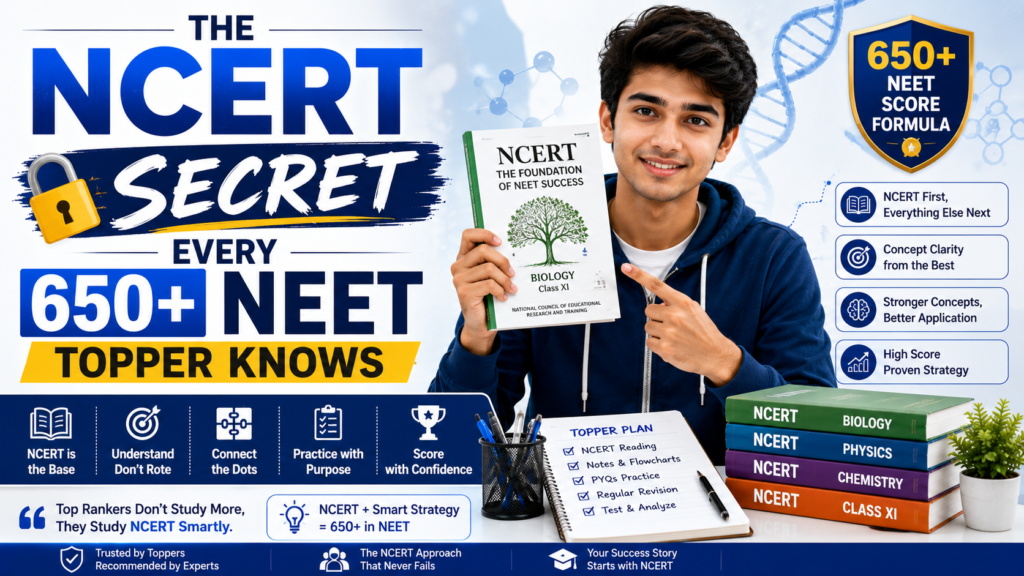
The NCERT Secret Every 650+ NEET Topper Knows (And How You Can Use It Too)
Every NEET aspirant dreams of scoring 650+ marks and securing admission to a top medical college. During this journey, students often search for the “perfect” reference book, the latest coaching material, or advanced question banks. However, when you listen to interviews with many high-scoring candidates, one resource appears again and again:
NCERT textbooks.
Does this mean NCERT alone guarantees a 650+ score? No. But it does mean that successful students consistently build their preparation around NCERT before moving on to additional practice resources.
So, what is the “NCERT secret” that many top performers understand? Let’s explore the study habits that help students make the most of these books.
Why NCERT Is the Foundation of NEET Preparation
The NEET syllabus is closely aligned with the NCERT curriculum, especially for Biology and significant portions of Chemistry. Understanding the concepts presented in these textbooks gives students a strong academic foundation.
Instead of rushing through multiple books, successful students usually focus on:
- Reading every chapter carefully.
- Understanding concepts instead of memorizing blindly.
- Revising regularly.
- Practicing MCQs based on the topics studied.
This approach helps build confidence over time.
Secret 1: Read NCERT More Than Once
Many students read NCERT once and immediately move to other books.
Top performers often revisit NCERT multiple times during their preparation.
With every revision, they notice:
- Important definitions
- Scientific terms
- Diagrams
- Tables
- Examples
- Small details that are easy to miss
Repeated reading strengthens memory and improves recall during the exam.
Secret 2: Don’t Skip the Diagrams
Students sometimes focus only on the text and ignore illustrations.
However, NCERT diagrams help explain biological processes and scientific concepts clearly.
A good habit is to:
- Study each diagram carefully.
- Learn the labels.
- Understand what each illustration represents.
- Revise diagrams regularly.
Visual learning often makes concepts easier to remember.
Secret 3: Build Conceptual Clarity
Scoring high in NEET requires more than memorization.
Ask yourself:
- Why does this process happen?
- How are these concepts connected?
- What is the application of this principle?
Understanding the “why” behind a topic improves problem-solving ability.
Secret 4: Make Short Notes
Instead of rewriting entire chapters, prepare concise revision notes.
Include:
- Key points
- Important formulas
- Biological terms
- Chemical reactions
- Frequently forgotten facts
These notes become extremely useful during the final weeks before NEET.
Secret 5: Practice MCQs After Every Chapter
Reading theory is only the first step.
After completing each chapter:
- Solve topic-wise MCQs.
- Review incorrect answers.
- Identify weak concepts.
- Revise before moving to the next chapter.
This habit helps convert knowledge into exam-ready performance.
Secret 6: Revise Regularly
Without revision, students forget what they have studied.
An effective revision schedule may include:
Daily Revision
Review the topics studied that day.
Weekly Revision
Go through all chapters completed during the week.
Monthly Revision
Take a mixed-topic test and revisit weaker areas.
Frequent revision helps retain information for the long term.
Subject-Wise NCERT Strategy
Biology
Biology has a significant weightage in NEET, making NCERT especially important.
Focus on:
- Definitions
- Diagrams
- Scientific terminology
- Tables
- Flowcharts
Read every chapter carefully rather than relying only on summaries.
Chemistry
For Chemistry:
- Understand Physical Chemistry concepts.
- Read Organic Chemistry mechanisms carefully.
- Revise Inorganic Chemistry from NCERT regularly.
Combine textbook study with problem-solving practice.
Physics
NCERT helps build the theoretical foundation for Physics.
However, students should also solve numerical problems and practice application-based questions to strengthen problem-solving skills.
Avoid Collecting Too Many Books
Many students believe that buying more books improves their preparation.
In reality:
- Too many resources create confusion.
- Revision becomes difficult.
- Time gets divided unnecessarily.
Master one reliable resource before moving to another.
Mock Tests Complete the Preparation
Even students who know NCERT well must practice under exam conditions.
Mock tests help improve:
- Speed
- Accuracy
- Time management
- Confidence
Most importantly, they reveal areas that need further revision.
Learn From Every Mistake
Instead of feeling discouraged after a poor test, treat mistakes as learning opportunities.
Maintain an error notebook where you record:
- Incorrect questions
- Correct concepts
- Common calculation errors
- Frequently forgotten facts
Review this notebook regularly.
Stay Consistent
Preparing for NEET is a marathon, not a sprint.
Students who study consistently over many months often perform better than those who rely on last-minute intensive study.
Small daily improvements create significant long-term results.
Healthy Habits Matter Too
Academic preparation should be supported by:
- Adequate sleep
- Balanced nutrition
- Regular exercise
- Short study breaks
- Positive mindset
Good health improves concentration and memory.
Tips for Parents
Parents can support students by:
- Encouraging realistic study goals.
- Creating a peaceful learning environment.
- Avoiding unnecessary comparisons.
- Appreciating consistent effort.
- Supporting emotional well-being throughout preparation.
Final Thoughts
The “NCERT secret” is not a hidden shortcut or magic formula. It is the disciplined habit of understanding concepts, revising regularly, practicing questions, and returning to the fundamentals repeatedly.
Students who build their preparation around NCERT, strengthen their concepts, and combine textbook learning with consistent MCQ practice and mock tests give themselves a solid foundation for success.
Scoring 650+ in NEET depends on many factors, including preparation quality, exam performance, and consistency. While no single resource guarantees a particular score, using NCERT effectively can be an important part of a strong preparation strategy.
Stay consistent, trust the process, and focus on improving every day. Success is built one chapter, one revision session, and one practice test at a time.
Frequently Asked Questions (FAQs)
1. Is NCERT enough to score 650+ in NEET?
NCERT provides the foundation, especially for Biology and much of Chemistry. Students should also practice MCQs, solve previous years’ questions, and take mock tests for comprehensive preparation.
2. How many times should I read NCERT?
There is no fixed number. Many successful students revise NCERT multiple times throughout their preparation to strengthen understanding and retention.
3. Is NCERT important for Physics?
Yes. NCERT helps build conceptual understanding, but students should supplement it with numerical practice and application-based questions.
4. Should I study multiple reference books?
It’s generally better to master NCERT and a limited number of quality resources rather than switching between many books.
5. What is the biggest advantage of NCERT?
NCERT provides clear concepts, structured explanations, and a strong academic foundation that supports effective NEET preparation when combined with regular revision and practice.