
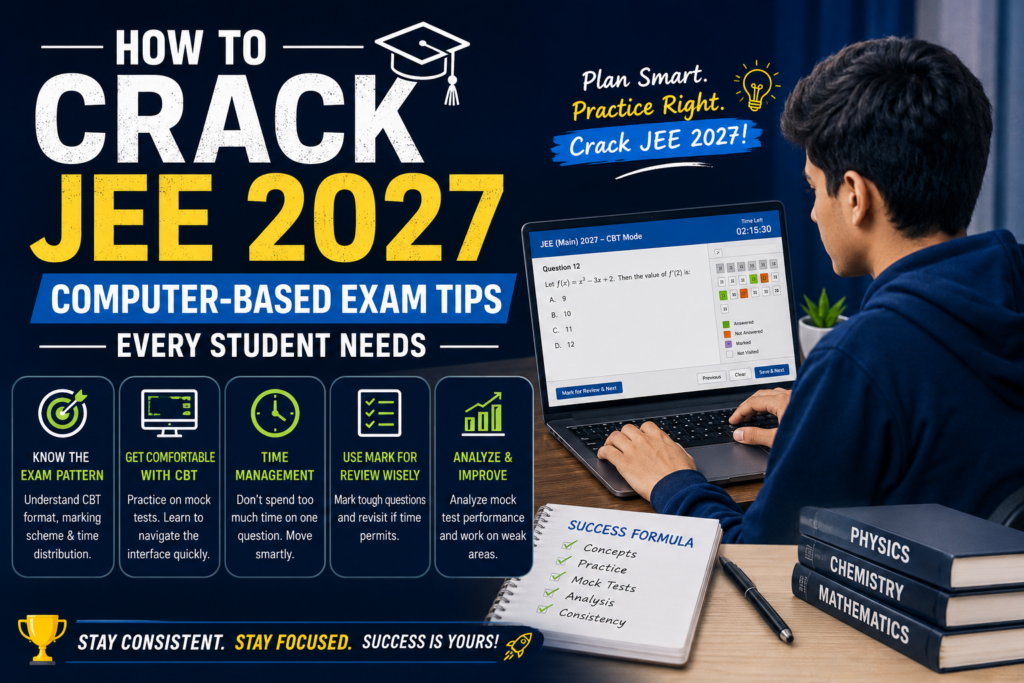
How to Crack JEE 2027: Computer-Based Exam Tips Every Student Needs
Preparing for the Joint Entrance Examination (JEE) is one of the biggest academic challenges for engineering aspirants in India. Every year, lakhs of students compete for admission to prestigious engineering institutions, making preparation, consistency, and strategy just as important as intelligence.
Since JEE Main is conducted as a Computer-Based Test (CBT), students need to master not only Physics, Chemistry, and Mathematics but also the digital exam environment. Many well-prepared students lose valuable marks because they are unfamiliar with computer-based navigation, time management, or exam pressure.
This comprehensive guide will help you understand how to prepare effectively for JEE 2027, develop strong concepts, improve speed and accuracy, and confidently tackle the computer-based exam.
Understanding the JEE Computer-Based Test (CBT)
JEE Main is conducted online, meaning candidates answer questions on a computer at the examination center instead of using paper and pen. While the exam tests academic knowledge, it also requires students to be comfortable using a digital interface.
The exam platform allows students to:
- Navigate between questions
- Mark questions for review
- Change answers before submission
- Monitor the remaining time
- View question palettes indicating answered and unanswered questions
Becoming familiar with this interface before exam day can reduce stress and improve confidence.
Why Computer-Based Practice Matters
Many students prepare well academically but practice only on paper. Although solving questions in notebooks is important, regular computer-based practice provides additional benefits.
It helps students:
- Improve screen-reading speed
- Become comfortable solving questions digitally
- Develop effective time management
- Reduce exam-day anxiety
- Build confidence with the online interface
Practicing in conditions similar to the real exam can make a noticeable difference.
Build Strong Fundamentals First
Before attempting advanced questions, focus on understanding concepts.
Avoid memorizing formulas without knowing how they work.
Instead:
- Understand the theory behind each concept.
- Learn how formulas are derived.
- Solve basic questions before attempting advanced problems.
- Strengthen conceptual clarity in all three subjects.
A strong foundation makes solving difficult questions much easier.
Subject-Wise Preparation Strategy
Physics
Physics rewards conceptual understanding and problem-solving ability.
Study Tips
- Learn concepts before formulas.
- Practice numerical questions daily.
- Revise important derivations.
- Solve previous years’ JEE questions.
- Analyze mistakes carefully.
Important topics include:
- Mechanics
- Electricity and Magnetism
- Modern Physics
- Optics
- Thermodynamics
Chemistry
Chemistry is divided into three sections, each requiring a different preparation strategy.
Physical Chemistry
- Understand formulas.
- Practice numerical problems regularly.
- Focus on calculation accuracy.
Organic Chemistry
- Learn reaction mechanisms.
- Practice conversion-based questions.
- Revise named reactions frequently.
Inorganic Chemistry
- Read NCERT thoroughly.
- Make concise revision notes.
- Revise periodically instead of cramming.
Mathematics
Mathematics requires continuous practice.
Students should:
- Solve questions every day.
- Learn shortcut techniques only after mastering concepts.
- Improve calculation speed.
- Revise formulas regularly.
Key topics include:
- Calculus
- Coordinate Geometry
- Algebra
- Vectors
- Probability
Create a Realistic Daily Study Schedule
A consistent routine is more effective than studying long hours irregularly.
A sample daily plan:
- Physics – 2.5 hours
- Chemistry – 2 hours
- Mathematics – 3 hours
- Mock questions – 1 hour
- Revision – 1 hour
Take short breaks between sessions to maintain concentration.
Weekly Study Goals
Each week should include:
- Completion of planned chapters
- Chapter-wise practice tests
- Revision of previously studied topics
- Analysis of mistakes
- One computer-based mock test
Weekly tracking helps maintain steady progress.
Master Time Management
Time management is critical during JEE.
Students should practice:
- Solving easier questions first
- Avoiding excessive time on one question
- Returning to difficult questions later
- Monitoring remaining time regularly
The objective is to maximize accuracy while attempting an optimal number of questions.
Learn to Use the Question Palette Effectively
The computer interface includes a question palette that helps candidates monitor their progress.
Use it to:
- Identify unanswered questions
- Return to marked questions
- Track completed sections
- Plan the remaining exam time
Developing this habit during mock tests improves efficiency.
Importance of Mock Tests
Mock tests should become a regular part of preparation.
Benefits include:
- Better speed
- Improved accuracy
- Familiarity with CBT
- Reduced anxiety
- Better decision-making
After every mock test:
- Review incorrect answers.
- Identify weak topics.
- Revise immediately.
- Practice similar questions.
Improvement comes from analyzing mistakes, not simply taking more tests.
Solve Previous Years’ Question Papers
Previous papers reveal:
- Frequently tested concepts
- Question patterns
- Difficulty level
- Time distribution
Students should solve papers under timed conditions to simulate the actual examination.
Develop Smart Revision Techniques
Revision should be systematic.
Daily Revision
Spend 30–45 minutes revising topics studied that day.
Weekly Revision
Review all chapters completed during the week.
Monthly Revision
Attempt a full-length computer-based mock test and revise important concepts.
Reduce Screen Anxiety
Some students become uncomfortable reading long questions on a computer screen.
To overcome this:
- Practice online regularly.
- Read carefully without rushing.
- Adjust your focus instead of staring continuously.
- Take short eye breaks during preparation.
Comfort with digital reading develops gradually.
Common Mistakes Students Should Avoid
Many students lose marks because of avoidable mistakes.
Avoid:
- Ignoring NCERT fundamentals
- Collecting too many reference books
- Skipping revision
- Avoiding mock tests
- Guessing excessively
- Spending too much time on difficult questions
- Neglecting sleep before the exam
Simple discipline often outperforms complicated study plans.
Health and Productivity
Academic preparation should be supported by healthy habits.
Students should:
- Sleep 7–8 hours daily.
- Stay hydrated.
- Exercise regularly.
- Eat nutritious meals.
- Take short breaks.
Physical health directly affects concentration and memory.
Final Three Months Before JEE
This period should focus on performance improvement.
Prioritize:
- Full-syllabus revision
- Computer-based mock tests
- Formula revision
- Previous years’ papers
- Weak-topic improvement
- Time management practice
Avoid starting completely new study materials unless absolutely necessary.
Tips for Parents
Parents can support students by:
- Providing a distraction-free study environment
- Encouraging healthy routines
- Avoiding unnecessary comparisons
- Appreciating consistent effort
- Supporting emotional well-being during preparation
Positive encouragement can boost confidence significantly.
Exam Day Tips
Before the exam:
- Reach the center early.
- Stay calm.
- Read instructions carefully.
- Begin with familiar questions.
- Manage time wisely.
- Review marked questions if time permits.
Confidence grows from preparation, not last-minute cramming.
Conclusion
Cracking JEE 2027 requires much more than subject knowledge. Students need conceptual clarity, disciplined study habits, regular revision, computer-based practice, and effective time management.
The computer-based exam format should not be viewed as a challenge but as an opportunity to demonstrate preparation under modern testing conditions. By practicing regularly in a digital environment, analyzing mistakes, and maintaining a healthy routine, students can significantly improve their performance.
Success in JEE is built one chapter, one revision session, and one mock test at a time. Stay focused, trust your preparation, and remain consistent throughout your journey.
Frequently Asked Questions (FAQs)
1. Is JEE 2027 a computer-based exam?
Yes. JEE Main is conducted as a Computer-Based Test (CBT), so students should practice using online mock tests to become familiar with the exam interface.
2. How many hours should I study daily for JEE 2027?
A focused schedule of 6–8 productive hours, combined with regular revision and mock tests, is generally more effective than studying for long hours without planning.
3. Are computer-based mock tests important?
Yes. They improve familiarity with the online exam environment, help develop time management skills, and reduce exam-day anxiety.
4. Which books should I use for JEE preparation?
Start with NCERT for strong fundamentals, then use standard reference books recommended by your teachers or coaching institute. Avoid collecting too many resources.
5. What is the key to scoring well in JEE?
Conceptual understanding, consistent practice, regular revision, computer-based mock tests, smart time management, and disciplined preparation are the key factors that contribute to success.