
Residential Coaching in 2026: Balancing Academic Success and Student Mental Well-Being
For many families, residential coaching programs are an attractive option for students preparing for competitive examinations such as NEET, JEE, and other entrance tests. These programs provide structured schedules, supervised study hours, and access to experienced faculty. However, choosing residential coaching involves more than comparing academic results—it also requires considering whether the environment is a good fit for the individual student.
Every student learns differently. While some thrive in a residential setting, others perform better with the support of their family and a day-scholar routine. Understanding both the benefits and challenges can help parents make an informed decision.
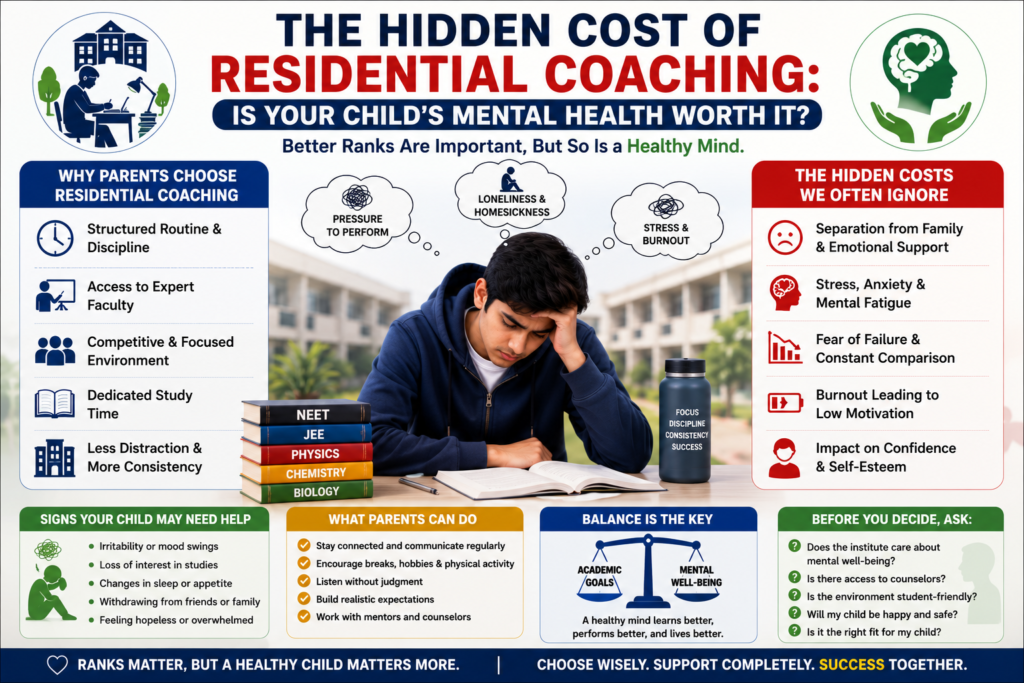
Why Parents Choose Residential Coaching
Residential coaching offers several advantages:
- Structured daily schedules
- Dedicated study time
- Easy access to teachers
- Peer learning opportunities
- Reduced travel time
- Academic discipline
For many students, these features create an environment that supports focused preparation.
Every Student Is Different
Not every student responds to the same environment in the same way.
Some students adapt quickly to hostel life, while others may take longer to adjust. Factors such as personality, independence, emotional resilience, and previous experience away from home can all influence how comfortable a student feels.
Parents should think about their child’s individual needs rather than assuming one model works for everyone.
The Importance of Mental Well-Being
Preparing for competitive exams can be demanding regardless of where a student studies.
Supporting mental well-being includes:
- Maintaining healthy sleep habits
- Taking regular study breaks
- Encouraging physical activity
- Building realistic expectations
- Having access to supportive teachers or counselors
- Staying connected with family
A healthy routine can improve concentration, motivation, and long-term performance.
Signs That a Student May Need Extra Support
Parents and educators should pay attention if a student experiences:
- Persistent sadness or withdrawal
- Difficulty sleeping
- Loss of motivation
- Significant changes in eating habits
- Trouble concentrating
- Feeling overwhelmed for extended periods
These signs do not necessarily relate to residential coaching specifically, but they may indicate that additional support is needed.
Questions Parents Should Ask Before Choosing a Residential Program
Before enrolling, consider asking:
- What is the student-to-faculty ratio?
- Are counseling or student support services available?
- How are students monitored academically and emotionally?
- How often can parents communicate with their children?
- What recreational activities are provided?
- What is the daily schedule?
- How does the institution help students who are struggling?
The answers can provide valuable insight into the overall learning environment.
Helping Students Succeed
Whether a student is a day scholar or in residential coaching, success depends on:
- Consistent study habits
- Conceptual understanding
- Regular revision
- Mock test practice
- Healthy routines
- Positive encouragement
A supportive environment often contributes as much to success as academic resources.
Conclusion
Residential coaching can be an excellent choice for some students, while others may flourish in a day-scholar setting. The best decision depends on the student’s learning style, personality, academic goals, and support needs.
Instead of focusing only on reputation or results, parents should consider the complete educational experience—including academic quality, student well-being, mentorship, and personal growth. Choosing an environment where a student feels supported and motivated is one of the most important investments in their future.
Frequently Asked Questions
1. Is residential coaching suitable for every student?
No. Some students thrive in residential programs, while others perform better as day scholars. The right choice depends on the student’s personality, learning style, and individual needs.
2. Does residential coaching improve academic performance?
Residential coaching can provide structure, access to faculty, and focused study time. However, success ultimately depends on consistent effort and effective learning habits.
3. How can parents support children in residential coaching?
Parents can maintain regular communication, encourage healthy routines, listen to concerns, and work with teachers when additional support is needed.
4. What should parents look for when selecting a residential coaching program?
Evaluate faculty, academic support, student welfare services, safety, counseling availability, communication policies, and the overall learning environment.
5. Which is better: residential coaching or day scholar?
Neither option is universally better. The best choice depends on what helps the individual student learn effectively while maintaining academic progress and overall well-being