
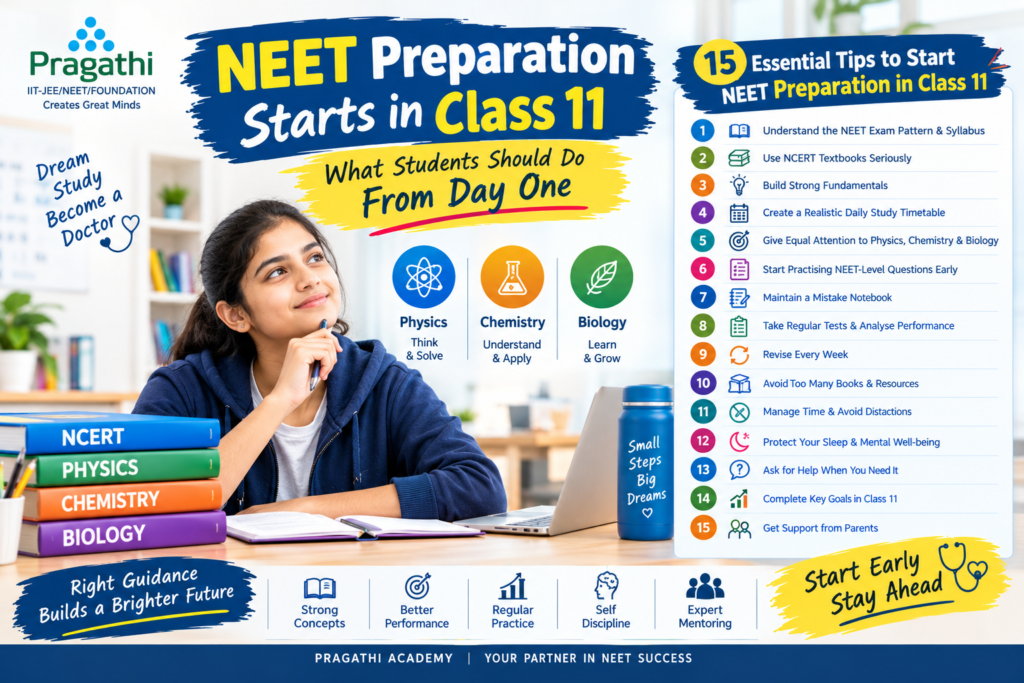
NEET Preparation Starts in Class 11: What Students Should Do From Day One
Preparing for NEET is a major step for students who dream of becoming doctors. For many students, Class 11 is the beginning of their journey towards a career in medicine. It is also the stage when they encounter new subjects, more complex concepts, and a different level of academic competition.
One common mistake students make is waiting until Class 12 to take NEET preparation seriously. By then, they may have to manage unfinished Class 11 topics alongside their current syllabus, leaving less time for revision and practice.
Starting NEET preparation in Class 11 gives students an opportunity to build strong fundamentals, develop effective study habits, and understand the examination pattern gradually.
However, starting early does not mean studying all day or putting unnecessary pressure on yourself. It means following a clear plan, studying consistently, revising regularly, and asking for help whenever needed.
In this guide, we explain what students should do from day one of Class 11 to prepare effectively for NEET.
1. Understand the NEET Exam Before You Begin
Before opening your textbooks, understand what NEET involves and what your preparation requires.
NEET-UG is the national-level entrance examination used for admission to undergraduate medical courses, subject to the applicable eligibility and admission rules.
The examination primarily tests students’ understanding of:
- Physics
- Chemistry
- Biology, including Botany and Zoology
Students should understand the current examination pattern, syllabus, marking scheme, eligibility requirements, and official instructions.
These details can change, so always check the latest information published by the National Testing Agency (NTA) and the relevant official authorities.
What should you do on day one?
Start with these simple steps:
- Download the latest official NEET syllabus.
- Understand the examination pattern.
- Collect the required NCERT textbooks.
- Review your Class 11 academic timetable.
- Create a realistic weekly study plan.
- Identify your current strengths and weaknesses.
You do not need to solve difficult questions immediately. First, understand the journey ahead and organise your preparation.
2. Take NCERT Textbooks Seriously
NCERT textbooks are an essential part of NEET preparation, particularly for Biology and Chemistry. Students should read the relevant NCERT chapters carefully and understand the concepts rather than memorising every line without context.
Biology
Biology requires careful reading, conceptual understanding, and repeated revision.
Pay attention to:
- Definitions and terminology
- Important examples
- Diagrams and their labels
- Tables and comparisons
- Biological processes
- Scientific names and classifications where relevant
After studying a topic, close your textbook and try to recall the main points. Then reopen it and check what you missed.
Chemistry
Chemistry includes Physical, Organic, and Inorganic Chemistry. Each area requires a slightly different approach.
- Physical Chemistry: Understand concepts, formulas, calculations, and numerical problems.
- Organic Chemistry: Learn fundamental concepts, reaction patterns, and mechanisms as appropriate to your syllabus.
- Inorganic Chemistry: Focus on conceptual understanding, textbook details, trends, and regular revision.
Physics
Physics requires more than reading theory. Students must understand concepts and apply them to numerical problems.
For every chapter:
- Understand the basic concept.
- Learn the relevant formulas and their applications.
- Study solved examples.
- Practise simple questions.
- Progress to NEET-level questions.
- Review mistakes.
Remember: Reading NCERT is important, but reading alone is not enough. Students also need practice, revision, and regular testing.
3. Build Strong Fundamentals in Class 11
Class 11 introduces many concepts that become important foundations for later learning.
Students sometimes struggle because they attempt advanced questions before understanding the basics.
Instead, follow this sequence:
Concept → Solved Example → Practice → Test → Revision
For example, when studying a Physics chapter, make sure you understand the underlying principle before attempting complex numerical problems.
In Chemistry, learn the fundamental concepts before moving to more complicated reactions or calculations.
In Biology, understand how a process works instead of simply memorising individual statements.
If a concept is unclear, revisit it before moving ahead. Small gaps can become bigger problems when later chapters depend on the same knowledge.
4. Create a Realistic Daily Study Timetable
A timetable helps students balance Intermediate academics, NEET preparation, revision, tests, and personal time.
However, the best timetable is not necessarily the one with the most study hours. It is the one students can follow consistently.
Here is an illustrative daily study plan for a student attending regular classes.
| Activity | Suggested Time |
|---|---|
| Review previous lessons | 30 minutes |
| Physics practice | 45–60 minutes |
| Chemistry revision or practice | 45–60 minutes |
| Biology reading and recall | 45–60 minutes |
| Questions and error review | 30 minutes |
Adjust the schedule according to your college timings, homework, current preparation level, and energy.
On particularly busy days, focus on completing the most important tasks rather than abandoning the timetable altogether.
Follow the weekly rule
At the end of each week, ask yourself:
- Did I complete the planned chapters?
- Which concepts are still unclear?
- Did I revise older topics?
- How many practice questions did I attempt?
- What mistakes did I repeat?
This simple review helps you identify problems before they accumulate.
5. Give Equal Attention to Physics, Chemistry and Biology
Many NEET aspirants spend most of their time studying Biology because they find it more comfortable. Others avoid Physics because they struggle with calculations.
Both approaches can create difficulties.
A balanced preparation plan should give appropriate attention to all three subjects.
How to manage each subject
Physics: Practise numerical problems regularly and strengthen your understanding of concepts and formulas.
Chemistry: Balance conceptual learning, calculations, reaction understanding, and textbook revision.
Biology: Read carefully, revise frequently, practise questions, and use active recall.
You can adjust the amount of time spent on each subject depending on your performance. A weaker subject may need additional practice, but do not neglect the others.
The objective is to develop balanced preparation rather than relying on one strong subject to compensate for every weakness.
6. Start Practising NEET-Level Questions Early
Students do not have to wait until they complete the entire syllabus before practising entrance-exam questions.
Start with basic questions related to the chapter you have just studied. Gradually increase the difficulty as your understanding improves.
A useful progression is:
- Textbook examples
- Basic conceptual questions
- Chapter-wise NEET questions
- Previous years’ questions
- Mixed-topic practice
- Timed tests
When you get a question wrong, do not immediately look at the answer and move on.
Ask yourself:
- Did I misunderstand the concept?
- Did I forget a formula or fact?
- Did I misread the question?
- Was my calculation incorrect?
- Did I spend too much time on the problem?
Understanding why an answer was wrong is one of the most valuable parts of preparation.
7. Maintain a Mistake Notebook
A mistake notebook is a simple but useful tool for NEET aspirants.
Use it to record questions or concepts that repeatedly cause problems.
You can divide the notebook into three sections:
- Concept mistakes: You did not understand the underlying principle.
- Memory mistakes: You forgot a fact, formula, or important detail.
- Application mistakes: You understood the concept but could not apply it correctly.
For every mistake, write a short explanation of the correct approach.
Review this notebook weekly and before major tests.
Over time, it can help you recognise recurring patterns and focus your revision on areas that need improvement.
8. Take Regular Tests and Analyse Your Performance
Tests help students measure progress and understand how well they can apply what they have learned.
In Class 11, begin with chapter-wise tests. As you cover more topics, introduce cumulative tests that include previously studied chapters.
After each test, review:
- Accuracy
- Time management
- Unattempted questions
- Incorrect answers
- Weak chapters
- Repeated mistakes
Do not judge your potential based on one test score.
A low score can indicate that you need more practice, stronger fundamentals, or a different revision strategy.
Likewise, a high score does not mean you can stop revising.
The real purpose of testing is to improve your next performance.
9. Revise Every Week Instead of Waiting Until Exams
One of the biggest challenges in NEET preparation is forgetting topics studied several weeks earlier.
Students often understand a chapter when it is first taught but struggle to recall the same information during a test.
Regular revision can help solve this problem.
Try a simple revision cycle:
- Same day: Briefly review the concepts learned in class.
- Later in the week: Solve questions and revisit important points.
- After a few weeks: Test your memory and understanding again.
- Before a major test: Revise the chapter and review previous mistakes.
You can adjust these intervals according to the subject and your ability to remember the material.
For Biology, practise recalling important information without looking at the textbook.
For Physics and Physical Chemistry, solve questions again instead of only reading formulas.
For Organic Chemistry, revisit fundamental concepts and practise applying them to reactions.
10. Avoid Collecting Too Many Books and Resources
Some students believe that using more books automatically improves their preparation.
They may purchase multiple question banks, join several online courses, and save hundreds of study videos. Eventually, they spend more time choosing resources than using them.
A better approach is to keep your resources manageable.
Start with:
- NCERT textbooks
- Your college or coaching study material
- A reliable set of practice questions
- Previous years’ NEET questions
- A test series appropriate to your preparation
Use additional resources when they address a specific learning need.
Before starting a new book or course, ask yourself whether you have completed and revised the material you already use.
Consistency with a few suitable resources is generally more useful than incomplete study from many different sources.
11. Manage Your Time and Avoid Distractions
Social media, gaming, unnecessary notifications, and unplanned screen time can interrupt study sessions.
You do not need to eliminate every form of entertainment, but you should decide when and how you use it.
Practical strategies include:
- Keep your phone away during focused study.
- Study in a clean, organised space.
- Set one clear target for each session.
- Take short breaks between study periods.
- Avoid switching between several subjects unnecessarily.
- Use a checklist to track completed work.
If you find it difficult to concentrate for long periods, begin with shorter sessions and gradually increase them.
The aim is to develop sustainable study habits, not to follow an unrealistic routine for a few days.
12. Protect Your Sleep and Mental Well-Being
NEET preparation requires concentration, memory, and consistent effort. These are harder to maintain when students regularly sacrifice sleep or ignore their well-being.
Teenagers generally need around 8–10 hours of sleep per night. Individual needs can vary, but regularly staying up late to study can make learning and concentration more difficult.
Students should also make time for:
- Regular meals
- Physical activity
- Short breaks
- Hobbies and relaxation
- Supportive conversations with parents or mentors
Avoid comparing your progress constantly with classmates.
Every student begins with a different level of preparation. Focus on improving your own understanding, accuracy, and consistency.
If academic pressure becomes overwhelming, speak to a trusted parent, teacher, counsellor, or healthcare professional.
13. Ask for Help When You Need It
Students sometimes avoid asking questions because they worry that their classmates will judge them.
However, leaving a doubt unresolved can make the next chapter more difficult.
Ask your teacher for clarification when:
- You repeatedly make the same mistake.
- You cannot understand a basic concept.
- You struggle with a particular type of question.
- Your test performance declines.
- You cannot manage the syllabus within your available time.
You can also discuss your weekly progress with a parent or mentor.
The important thing is to identify difficulties early and take practical steps to address them.
14. What Should Students Complete During Class 11?
Class 11 is not just a year to attend classes and prepare for Intermediate examinations. It is an opportunity to build the academic foundation needed for the remaining preparation period.
By the end of the academic year, aim to:
- Understand the Class 11 syllabus covered in your course.
- Strengthen fundamental concepts in all three NEET subjects.
- Complete chapter-wise practice for studied topics.
- Revise older chapters regularly.
- Attempt chapter-wise and cumulative tests.
- Maintain a mistake notebook.
- Identify weak topics and work on them.
- Establish a sustainable daily study routine.
These are preparation goals, not reasons to panic if you fall behind.
If some topics remain incomplete, identify them, prioritise the most important concepts, and create a realistic plan to catch up.
Do not abandon current lessons while trying to finish every pending topic at once.
15. How Can Parents Support NEET Aspirants?
Parents play an important role in creating a supportive learning environment.
Instead of asking only about marks or ranks, ask your child what they learned and where they need help.
Parents can support students by:
- Providing a quiet study space.
- Helping maintain a healthy routine.
- Encouraging regular revision.
- Attending parent-teacher meetings.
- Discussing academic difficulties calmly.
- Avoiding comparisons with other students.
- Recognising effort and improvement.
It is also important to choose a college or coaching program carefully.
Consider faculty quality, teaching methods, doubt-clearing support, test analysis, study material, mentoring, travel time, fees, and student well-being.
A structured learning environment can help students stay organised, but the program should match the student’s needs and learning style.
Why Choose Pragathi Academy for NEET Preparation?
Students looking for structured NEET preparation in Hyderabad can explore the academic programs offered by Pragathi Academy.
When evaluating a NEET preparation program, students and parents should look for a clear syllabus plan, effective Biology, Physics and Chemistry teaching, regular practice, mock tests, doubt clarification, and individual academic guidance.
The right learning environment should help students build strong concepts, identify weaknesses, and develop consistent study habits.
Before admission, visit the campus, understand the course structure, ask about faculty and student support, and review the fee details. Choose a program that fits your child’s academic requirements and daily routine.
Frequently Asked Questions
1. Is Class 11 important for NEET preparation?
Yes. Class 11 introduces important concepts in Physics, Chemistry, and Biology. Building a strong foundation during this year can make subsequent learning, revision, and question practice more manageable.
2. How many hours should I study for NEET in Class 11?
There is no single number of hours that works for every student. Start with a realistic timetable that balances college classes, homework, revision and question practice. Focus on consistent, effective learning rather than simply counting hours.
3. Can I prepare for NEET using NCERT books alone?
NCERT is essential, particularly for Biology, but students also need question practice, revision, and tests. Additional material may be helpful for problem-solving and exam practice, depending on the topic and the student’s needs.
4. Should I start solving previous years’ NEET questions in Class 11?
Yes. You can practise previous years’ questions chapter by chapter as you complete the relevant topics. This helps you understand the style and level of questions without waiting for the entire syllabus to finish.
5. What should I do if I am weak in Physics?
Start by identifying the concepts you do not understand. Review the theory, study solved examples, practise basic numerical questions, and gradually progress to NEET-level problems. Ask your teacher for help when difficulties continue.
6. Is coaching necessary for NEET preparation?
Coaching is not compulsory for every student. Some students prepare independently, while others benefit from structured classes, faculty guidance, doubt-clearing sessions, and regular tests. Choose the approach that best supports your learning needs.
7. When should I start taking mock tests?
Begin with chapter-wise tests as soon as you finish individual topics. Gradually introduce cumulative tests as you cover more of the syllabus, and use full-length mock tests according to your preparation stage and the current exam requirements.
Final Thoughts
NEET preparation starts in Class 11, but success comes from what you do consistently every day.
Understand the syllabus, study NCERT carefully, strengthen your fundamentals, practise questions, revise regularly, analyse your mistakes, and seek help when necessary.
You do not need to become a perfect student on day one. You need to build habits that help you improve week after week.
For every NEET aspirant, Class 11 is an opportunity to create a strong foundation for the medical entrance examination and move closer to the dream of becoming a doctor.
Start early. Study smart. Revise consistently. Trust the process.