
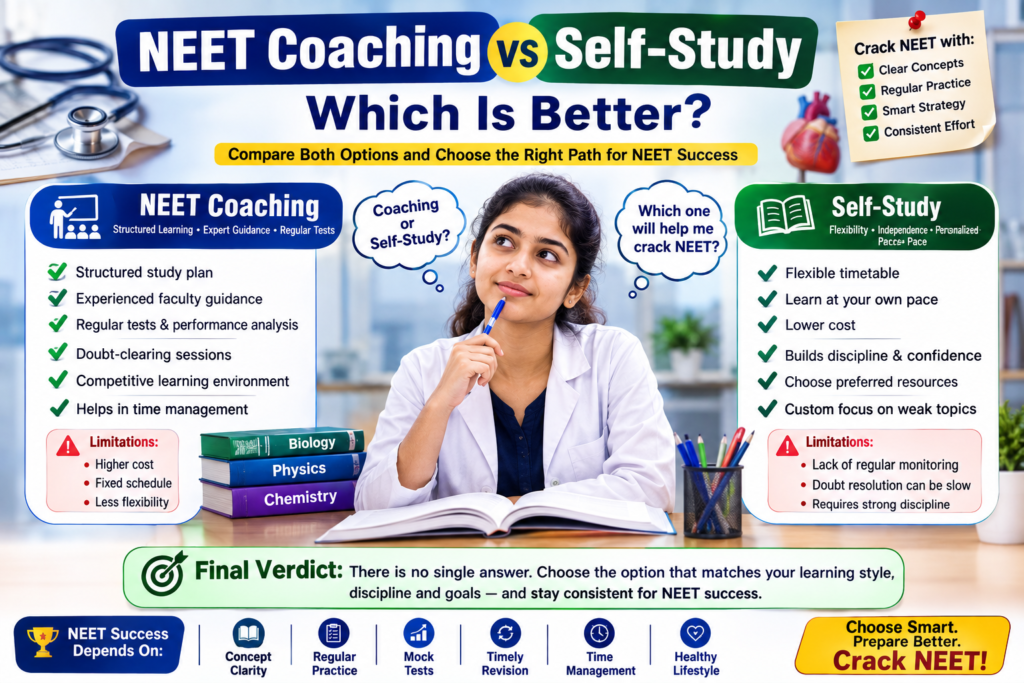
NEET Coaching vs Self-Study: Which Is Better?
Preparing for the National Eligibility cum Entrance Test (NEET) is a major academic journey for students who dream of pursuing medicine. After Class 10, many students and parents face an important question: Is NEET coaching better, or can a student crack NEET through self-study?
There is no single answer that works for every student. Some students perform well with structured coaching, regular tests, faculty guidance, and a fixed study schedule. Others are comfortable learning independently, creating their own timetable and finding resources on their own.
The right choice depends on the student’s academic foundation, discipline, learning style, time management, access to quality resources, and ability to stay consistent.
For students in Hyderabad, another option is an integrated junior college with NEET coaching, where Intermediate education and competitive-exam preparation are planned together. This can reduce the challenge of managing separate academic schedules.
This guide explains the differences between NEET coaching vs self-study, their advantages and disadvantages, and how students can decide which approach is suitable for them.
What Is NEET Coaching?
NEET coaching is a structured preparation system designed to help students prepare for the medical entrance examination.
A coaching program generally provides classroom teaching, study material, tests, revision schedules, doubt-clearing sessions and academic guidance.
For students studying BiPC in Intermediate, NEET coaching focuses mainly on:
- Biology
- Physics
- Chemistry
A structured coaching program can help students follow a planned syllabus instead of deciding every day what to study.
Depending on the institution, students may also receive:
- Chapter-wise tests
- Full-length mock tests
- Previous-question practice
- Performance analysis
- Doubt sessions
- Revision classes
- Mentoring
- Study schedules
The exact facilities vary from one coaching institute or junior college to another.
What Is NEET Self-Study?
Self-study means preparing for NEET independently without depending on regular classroom coaching.
A self-study student generally creates their own timetable, selects study materials, watches educational lessons when required, solves questions and evaluates their performance through tests.
Self-study can include:
- Reading NCERT textbooks
- Watching online lessons
- Solving practice questions
- Taking mock tests
- Revising chapters
- Making notes
- Analysing mistakes
- Following online educational resources
Self-study does not necessarily mean studying completely without guidance. Students can still use teachers, online resources, doubt-solving platforms and test series when required.
NEET Coaching vs Self-Study: Quick Comparison
| Factor | NEET Coaching | Self-Study |
|---|---|---|
| Study structure | Pre-planned | Student creates schedule |
| Faculty guidance | Regular | Limited or as needed |
| Doubt solving | Usually available | Student must find support |
| Study material | Often provided | Student selects resources |
| Tests | Scheduled regularly | Student must arrange them |
| Flexibility | Moderate | High |
| Time management | Easier for many students | Requires strong discipline |
| Cost | Usually higher | Can be lower |
| Personal pace | Depends on batch | Completely flexible |
| Competition | Peer learning environment | Mostly individual |
| Mentoring | May be available | Usually self-managed |
| Best suited for | Students needing structure | Independent and disciplined students |
Advantages of NEET Coaching
1. Structured Study Plan
One of the biggest advantages of coaching is structure.
NEET has a large syllabus, and students need to study consistently over a long period. A coaching program can divide the syllabus into manageable sections.
Instead of asking:
“What should I study today?”
students can follow a planned timetable.
This can make preparation more organized.
2. Experienced Faculty Guidance
NEET preparation involves many concepts that students may find difficult.
A good teacher can explain complicated topics, demonstrate problem-solving methods and identify common mistakes.
For example, Physics often requires students to understand concepts before solving numerical questions. Chemistry requires a combination of conceptual understanding, problem-solving and revision. Biology requires detailed and consistent study.
Having access to experienced teachers can reduce the time students spend struggling with difficult topics.
3. Regular Tests
Testing is an important part of competitive-exam preparation.
Coaching institutes generally conduct regular tests to evaluate student performance.
Tests can help students understand:
- Which subjects are strong
- Which chapters need revision
- Whether they are managing time effectively
- How accurately they answer questions
- Which mistakes they repeat
A test score is useful only when students analyse it and improve afterward.
4. Doubt-Clearing Support
Students inevitably have questions during NEET preparation.
With coaching, students can usually ask teachers about difficult concepts instead of spending a long time trying to solve every problem alone.
Regular doubt-solving can be particularly useful in Physics and Chemistry.
5. Competitive Environment
Studying alongside other NEET aspirants can create a healthy academic environment.
Students can compare their preparation level, participate in discussions and learn from classmates.
However, students should use competition positively and avoid constantly comparing themselves with others.
6. Academic Mentoring
Some students need help beyond classroom teaching.
Mentors can help students identify problems such as:
- Inconsistent study habits
- Poor revision
- Low test scores
- Lack of time management
- Exam anxiety
- Weak subjects
Good mentoring can help students develop better study habits.
Disadvantages of NEET Coaching
Coaching also has limitations.
1. Cost
Professional coaching can be expensive.
Parents should consider the complete cost, including tuition, study material, transportation, accommodation and other expenses.
2. Fixed Schedule
Students generally have to follow the coaching centre’s timetable.
This can be difficult for students who prefer studying at their own pace.
3. Large Batches
If a coaching centre has very large batches, individual attention may be limited.
Parents should ask about batch size and teacher-to-student interaction before admission.
4. Quality Varies
Not every coaching institute provides the same quality of teaching.
Parents should evaluate faculty, curriculum, tests, study material, mentoring, and student support instead of choosing solely based on advertisements.
Advantages of NEET Self-Study
1. Flexible Timetable
Self-study gives students complete control over their schedule.
A student can spend more time on difficult topics and move quickly through subjects they already understand.
For example, a student who is strong in Biology can dedicate more time to Physics or Chemistry.
2. Lower Cost
Self-study can significantly reduce coaching expenses.
Students can use textbooks, library resources, and free or affordable online educational resources.
However, students may still benefit from purchasing a good test series or additional study materials.
3. Personalized Learning
Every student has a different learning speed.
Self-study allows students to customize their preparation according to their strengths and weaknesses.
Students can pause lessons, repeat chapters, and revise difficult topics as many times as necessary.
4. Develops Independence
Self-study teaches students how to manage their own education.
This can improve:
- Time management
- Discipline
- Decision-making
- Self-assessment
- Problem-solving
These skills are useful beyond NEET preparation.
Disadvantages of NEET Self-Study
1. Lack of External Accountability
The biggest challenge for many students is consistency.
Without teachers or mentors checking progress, students may postpone difficult chapters or spend too much time on easier topics.
2. Difficulty Choosing Resources
There are thousands of books, videos, websites, and question banks available.
Having too many resources can create confusion.
Students should avoid continuously changing books and teachers.
3. Doubt Resolution
When a difficult concept appears, a self-study student may spend a lot of time trying to understand it independently.
Online resources can help, but finding a clear explanation may take time.
4. Limited Testing Discipline
A student must arrange their own tests and analyse the results.
Skipping tests can create a false sense of preparation.
5. Motivation Can Be Difficult
NEET preparation takes months of consistent effort.
Students studying alone may sometimes lose motivation.
A structured environment can help students remain accountable.
Which Is Better for Average Students?
Many students wonder whether self-study is suitable only for academically strong students.
That is not necessarily true.
An average student can improve significantly through consistent preparation, proper guidance and regular practice.
For students who struggle to maintain a timetable or understand difficult topics independently, coaching may provide useful support.
The important factor is not where a student starts. It is how consistently they improve.
Which Is Better for High-Performing Students?
High-performing students may have more flexibility.
If a student already has:
- Strong fundamentals
- Excellent discipline
- Good time management
- Reliable study resources
- Strong problem-solving skills
- Access to quality tests
then self-study can be effective.
However, even high-performing students may benefit from mock tests, expert guidance and performance analysis.
Self-study does not mean avoiding all external support.
Is Integrated NEET Coaching a Middle Option?
For Intermediate students, an integrated coaching program can offer a middle path between traditional coaching and completely independent preparation.
In an integrated program, Intermediate education and NEET preparation are combined.
This can help students avoid managing two completely separate academic systems.
Potential advantages include:
- Coordinated board and NEET preparation
- Regular classroom teaching
- Structured study timetable
- Competitive-exam tests
- Doubt-solving sessions
- Mentoring
- Reduced travel
- Academic monitoring
For students who want structured guidance but also need to complete Intermediate education, an integrated program can be worth considering.
How to Decide Between Coaching and Self-Study
Ask yourself these questions before making a decision.
Question 1: Can I Follow a Timetable Without Someone Monitoring Me?
If the answer is yes, self-study may be suitable.
If the answer is no, structured coaching may be helpful.
Question 2: Can I Understand Difficult Topics Independently?
If you can use textbooks and reliable educational resources effectively, self-study may work.
If you frequently need teacher explanations, coaching may be better.
Question 3: Can I Take Tests Regularly?
NEET preparation requires testing.
If you can consistently schedule and analyse mock tests, self-study becomes more practical.
Question 4: Do I Get Distracted Easily?
Students who struggle with distractions may benefit from a structured classroom environment.
Question 5: What Is My Budget?
Consider your family’s budget and compare the total cost of coaching with self-study.
Question 6: How Much Time Do I Spend Travelling?
If coaching involves long daily travel, calculate whether the academic benefit justifies the time spent commuting.
A Practical NEET Preparation Strategy
Whether you choose coaching or self-study, your preparation should include five major components.
1. Learn the Concept
Understand the topic before attempting difficult questions.
2. Study NCERT Carefully
NCERT should form an important part of your preparation, particularly for Biology.
3. Practise Questions
After studying a chapter, solve relevant questions.
4. Take Mock Tests
Regular tests help develop speed and accuracy.
5. Analyse Mistakes
Maintain a record of mistakes and revisit weak areas during revision.
Tips for Students Choosing Self-Study
If you decide to prepare independently, follow these guidelines:
Create a Realistic Timetable
Do not create an unrealistic schedule with extremely long study hours.
Focus on productive study.
Set Weekly Goals
Instead of thinking only about the complete syllabus, divide it into weekly targets.
Avoid Too Many Books
Select reliable resources and use them consistently.
Take Regular Tests
Do not wait until you finish the entire syllabus.
Maintain an Error Notebook
Write down serious mistakes and revise them regularly.
Track Your Progress
Monitor test scores and identify trends.
Get Help When Needed
Self-study does not mean refusing help.
Ask teachers, mentors, or reliable educational resources when you cannot understand a concept.
Tips for Students Choosing NEET Coaching
If you decide to join coaching, choose carefully.
Before admission, ask:
- Who teaches Biology, Physics and Chemistry?
- What is the batch size?
- How often are tests conducted?
- Is performance analysis provided?
- Are doubt sessions available?
- What study material is included?
- Is personal mentoring available?
- How is board preparation managed?
- What is the daily timetable?
- How much travel is required?
- What are the total fees?
- Are hostel facilities available if required?
Do not choose a coaching centre only because it claims to have produced top ranks.
Look at the overall academic system.
NEET Coaching at Pragathi Academy
Students searching for NEET coaching junior colleges in Hyderabad can also consider integrated BiPC programs that combine Intermediate education with competitive-exam preparation.
Pragathi Academy in Hyderabad offers BiPC education along with integrated NEET preparation. Its website highlights academic guidance, study materials, regular testing and mentoring as part of its approach. (Pragathi Academy)
An integrated environment can be useful for students who want their Intermediate and NEET preparation to follow a coordinated schedule rather than managing two separate institutions.
Students and parents should visit the campus, understand the current 2026–27 program, compare fees and facilities, and speak with the academic team before making an admission decision.
Frequently Asked Questions
Can I crack NEET without coaching?
Yes, students can prepare through self-study, provided they have strong discipline, reliable study resources, regular testing, and the ability to understand and revise the syllabus effectively.
Is coaching necessary for NEET?
Coaching is not automatically necessary for every student. It can be particularly useful for students who need structured teaching, regular tests, doubt-solving and academic monitoring.
Is self-study better than coaching?
Neither method is universally better. The better approach depends on the student’s learning style, discipline, academic foundation, resources and goals.
Can an average student crack NEET through self-study?
Yes, but consistent preparation is essential. Students need a realistic timetable, strong fundamentals, regular question practice, mock tests and continuous revision.
Is integrated NEET coaching better than separate coaching?
Integrated coaching can make it easier to coordinate Intermediate and NEET preparation and may reduce travel. However, students should compare teaching quality, faculty, tests, mentoring and course structure before choosing.
How many hours should a NEET student study?
No fixed number of hours guarantees success. Productive, focused study combined with adequate sleep, revision and regular testing is more important than simply counting study hours.
Final Verdict: NEET Coaching or Self-Study?
The debate between NEET coaching vs self-study does not have one universal winner.
NEET coaching may be the better option for students who need structure, teacher guidance, regular tests, mentoring, and a competitive learning environment.
Self-study may be the better option for disciplined students who can create a realistic timetable, choose reliable resources, solve questions independently and consistently evaluate their performance.
There is also a third option: integrated NEET coaching, where Intermediate education and competitive-exam preparation are combined in one academic system. This can be useful for students who want structured preparation without managing separate institutions.
Ultimately, success in NEET depends less on whether a student chooses coaching or self-study and more on consistency, conceptual understanding, question practice, revision, mock tests, and the willingness to learn from mistakes.
Before choosing a path, students and parents should honestly assess the student’s strengths, weaknesses, study habits and academic requirements.
The best preparation method is the one that helps the student stay consistent, understand concepts clearly, practise effectively and move confidently toward the goal of becoming a medical professional.