
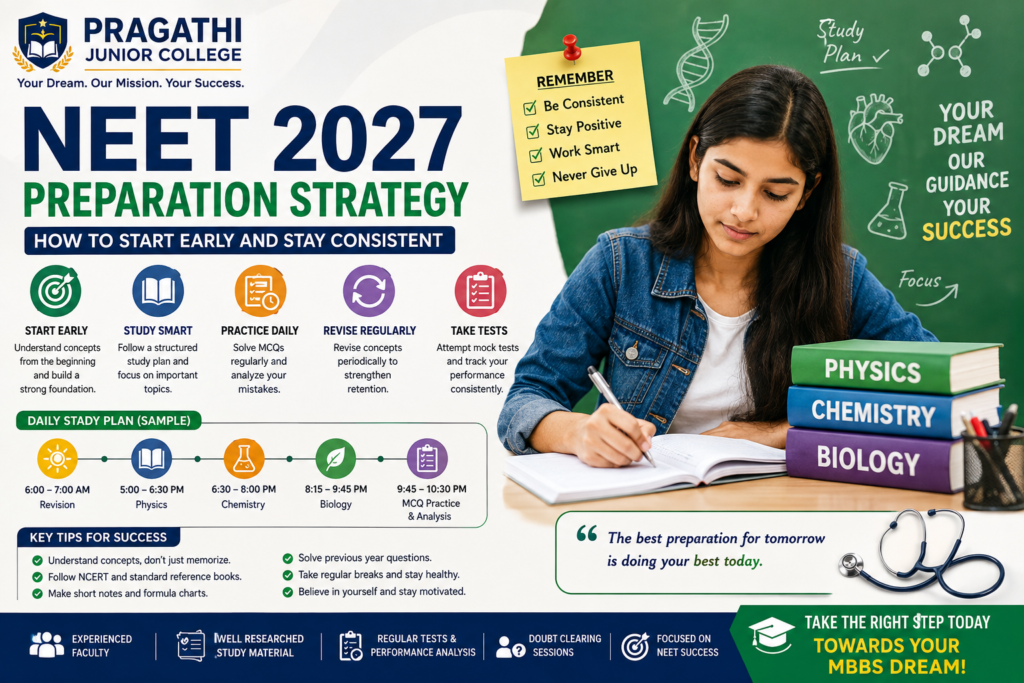
NEET 2027 Preparation Strategy: How to Start Early and Stay Consistent
Preparing for NEET 2027 is a major goal for students who dream of becoming doctors. With competition increasing every year, starting early gives students more time to understand concepts, strengthen fundamentals, practice questions, revise important topics, and build confidence.
For students entering Class 11, NEET preparation can feel overwhelming at first. The syllabus is extensive, the subjects require different study methods, and students must balance regular intermediate studies with competitive-exam preparation.
The good news is that students do not need to study everything at once. A well-planned strategy, consistent daily effort, regular revision, and proper guidance can make the preparation journey much more manageable.
This guide explains a practical NEET 2027 preparation strategy, including subject-wise preparation tips, study schedules, revision techniques, mock tests, common mistakes, and ways to stay motivated throughout the journey.
Why Start NEET 2027 Preparation Early?
NEET preparation involves concepts from Class 11 and Class 12, particularly Physics, Chemistry, and Biology. Starting early lets students cover the syllabus systematically instead of trying to complete many chapters in the final months.
Early preparation provides several advantages:
- More time to understand difficult concepts
- Better retention through repeated revision
- More opportunities to practice questions
- Time to identify weak topics
- Regular mock-test practice
- Better time management
- Less pressure during Class 12
- Improved confidence before the examination
Starting early does not mean studying for extremely long hours every day. It means developing the right habits from the beginning.
Understand the NEET 2027 Syllabus
Before creating a timetable, students should understand the official NEET syllabus and examination pattern applicable to their examination year.
NEET preparation mainly revolves around:
- Physics
- Chemistry
- Biology
Biology carries significant weight in the examination, while Physics and Chemistry require strong conceptual understanding and numerical or application-based practice.
Students should download and refer to the latest official syllabus rather than relying only on old preparation charts or random online lists.
Create a chapter checklist for each subject and mark topics as:
- Not started
- Learning
- Practicing
- Revised
- Strong
This simple system helps students track their progress.
NEET 2027 Preparation Strategy for Class 11
A successful preparation plan should focus on four major stages:
Learn → Practice → Revise → Test
Students should repeat this cycle throughout their preparation.
Step 1: Build Strong Fundamentals
Class 11 is the foundation of your NEET preparation.
Do not focus only on completing chapters quickly. Understanding the basics is more important.
For every chapter, make sure you can:
- Explain the main concepts.
- Understand important definitions and formulas.
- Solve basic questions.
- Apply concepts to NEET-level questions.
- Identify common mistakes.
- Revise the chapter regularly.
A strong foundation in Class 11 makes Class 12 preparation easier.
Biology Preparation Strategy for NEET 2027
Biology is one of the most important subjects for NEET aspirants.
Students should develop a habit of reading their core textbook carefully rather than depending entirely on coaching notes.
Important Class 11 Biology areas include:
- The Living World
- Biological Classification
- Plant Kingdom
- Animal Kingdom
- Morphology of Flowering Plants
- Anatomy of Flowering Plants
- Structural Organisation in Animals
- Cell Structure and Function
- Biomolecules
- Cell Cycle and Cell Division
- Transport in Plants
- Mineral Nutrition
- Photosynthesis
- Respiration in Plants
- Plant Growth and Development
- Digestion and Absorption
- Breathing and Exchange of Gases
- Body Fluids and Circulation
- Excretory Products and Elimination
- Locomotion and Movement
- Neural Control and Coordination
- Chemical Coordination and Integration
How to Study Biology
Read the prescribed textbook carefully and pay attention to diagrams, tables, terminology, processes, and important details.
After completing a chapter:
- Read it again during revision.
- Create short notes.
- Practice objective questions.
- Revise diagrams.
- Solve previous-year questions.
- Take chapter-wise tests.
Biology requires strong retention, so repeated revision should be part of your weekly routine.
Chemistry Preparation Strategy
Chemistry requires a balanced approach because different areas demand different study techniques.
The subject can broadly be approached through:
- Physical Chemistry
- Organic Chemistry
- Inorganic Chemistry
Physical Chemistry
Physical Chemistry involves concepts, formulas, calculations, and numerical problems.
Students should focus on understanding the basic principles before memorizing formulas.
Important Class 11 areas include:
- Some Basic Concepts of Chemistry
- Structure of the Atom
- Classification of Elements and Periodicity
- Chemical Bonding
- Thermodynamics
- Equilibrium
- Redox Reactions
- States of Matter
Maintain a formula notebook and solve numerical questions regularly.
Organic Chemistry
Organic Chemistry becomes easier when students understand the basic concepts properly.
Instead of memorizing reactions randomly, understand:
- Basic principles
- Chemical bonding
- Reaction mechanisms
- Important functional groups
- Reaction patterns
Build your Organic Chemistry knowledge step by step.
Inorganic Chemistry
Inorganic Chemistry requires conceptual learning combined with regular revision.
Pay attention to:
- Periodic properties
- Chemical bonding
- Element properties
- Important reactions
- Trends and exceptions
Regular revision is particularly important because information can be forgotten if it is not reviewed.
Physics Preparation Strategy for NEET 2027
Physics can be challenging for students who are not comfortable with numerical problems. The best way to improve is through consistent practice.
Important Class 11 areas include:
- Units and Measurements
- Motion
- Laws of Motion
- Work, Energy and Power
- System of Particles and Rotational Motion
- Gravitation
- Properties of Bulk Matter
- Thermodynamics
- Kinetic Theory
- Oscillations
- Waves
How to Study Physics
Start with the concept.
Then:
Concept → Formula → Example → Practice → Test
Do not simply memorize formulas. Understand when and how each formula should be applied.
Solve questions at different difficulty levels and keep track of questions that you repeatedly get wrong.
A mistake notebook can help you identify whether your problem is:
- Conceptual understanding
- Formula selection
- Calculation
- Time management
- Careless mistakes
Create a Practical NEET Study Timetable
A timetable should be realistic.
Students often make the mistake of planning extremely long study sessions that are difficult to maintain.
Instead, focus on quality and consistency.
A sample daily schedule could look like this:
| Time | Activity |
|---|---|
| 5:30 AM – 6:00 AM | Wake up and get ready |
| 6:00 AM – 7:00 AM | Biology revision |
| College Hours | Classes and academic work |
| 4:30 PM – 5:00 PM | Break |
| 5:00 PM – 6:30 PM | Physics |
| 6:30 PM – 7:00 PM | Break |
| 7:00 PM – 8:30 PM | Chemistry |
| 8:30 PM – 9:00 PM | Dinner |
| 9:00 PM – 10:00 PM | Biology / MCQ practice |
| 10:00 PM – 10:20 PM | Revision and next-day planning |
The timings can be adjusted according to your college schedule and personal routine.
The important point is to maintain a consistent study cycle.
Use the 60-30-10 Revision Rule
Students can divide their revision time into three parts:
60% – Current topics
Focus on chapters currently being taught.
30% – Previous topics
Revise older chapters to prevent forgetting.
10% – Weak areas
Spend dedicated time on topics where your performance is low.
This approach prevents students from completely forgetting older chapters while continuing with new ones.
Practice MCQs Every Day
NEET is an objective examination, so solving multiple-choice questions is essential.
After learning a topic, solve relevant MCQs.
Start with straightforward questions and gradually move toward more application-based problems.
When reviewing your answers, divide mistakes into three categories:
Concept Mistake
You did not understand the concept.
Careless Mistake
You knew the answer but made an avoidable error.
Time-Management Mistake
You spent too much time on the question.
Understanding the type of mistake is just as important as knowing the correct answer.
Make Revision a Daily Habit
One of the biggest challenges in NEET preparation is forgetting previously studied topics.
A chapter studied several months ago may not remain fresh without revision.
Use short and regular revision sessions.
For example:
Day 1: Learn the chapter
Day 3: Quick revision
Day 7: Practice questions
Day 15: Revision
Day 30: Test
The exact schedule can be adjusted, but the principle remains the same: learn repeatedly, not just once.
Take Regular Mock Tests
Tests should not be postponed until the final year.
Start with chapter-wise tests and gradually progress to larger tests.
A good testing schedule can include:
- Chapter tests
- Subject-wise tests
- Part-syllabus tests
- Full-syllabus tests
- NEET-pattern mock tests
After each test, analyze your performance.
Do not look only at your score.
Check:
- Accuracy
- Time spent
- Questions left unanswered
- Repeated mistakes
- Weak chapters
- Strong chapters
Your test analysis can tell you what to study next.
Maintain a Mistake Notebook
A mistake notebook is a simple but powerful preparation tool.
Whenever you make an important mistake, write down:
- Question or concept
- Your answer
- Correct answer
- Why you made the mistake
- Correct method
- Important takeaway
Review this notebook regularly before tests.
The objective is not to record every small mistake but to identify repeated or important errors.
How to Stay Consistent During NEET Preparation
Consistency is often more important than studying for extremely long hours.
Here are some practical habits that can help:
Set Weekly Goals
Instead of thinking about the entire NEET syllabus every day, create weekly targets.
For example:
- Complete two Physics chapters
- Revise one Chemistry unit
- Finish selected Biology chapters
- Solve a specific number of MCQs
- Take one test
Reduce Distractions
Keep your phone away during study sessions.
If you use your phone for educational purposes, turn off unnecessary notifications.
Track Your Progress
Use a simple notebook, calendar, or digital tracker.
Mark completed chapters and tests.
Seeing progress can improve motivation.
Take Short Breaks
Long study sessions without breaks can reduce concentration.
Short breaks between study blocks can help you stay focused.
Sleep Properly
NEET preparation is a long-term process. Proper sleep is important for concentration, learning, and memory.
Do not sacrifice sleep regularly just to increase study hours.
Common Mistakes NEET Aspirants Should Avoid
1. Starting Without a Plan
Studying random chapters every day can create gaps.
Follow a structured syllabus plan.
2. Ignoring Class 11
Class 11 topics are an important part of NEET preparation.
Do not leave them for the last minute.
3. Studying Only Biology
Biology is important, but Physics and Chemistry also require consistent preparation.
Maintain a balanced schedule.
4. Avoiding Physics Numericals
Reading Physics theory without solving questions is not enough.
Practice numerical problems regularly.
5. Skipping Revision
Completing a chapter does not mean the chapter is permanently learned.
Revise it multiple times.
6. Taking Too Few Tests
Tests help students understand their preparation level.
Start testing early.
7. Comparing Yourself With Others
Every student has a different learning speed.
Focus on your own improvement rather than constantly comparing your marks with classmates.
A Two-Year NEET 2027 Roadmap
Class 11 – Foundation Year
Focus on:
- Understanding fundamental concepts
- Completing Class 11 syllabus
- Developing daily study habits
- Practicing MCQs
- Regular chapter tests
- Building revision habits
Summer / Transition Period
Use the break to revise Class 11 topics and strengthen weak areas.
Avoid spending the entire vacation without academic revision.
Class 12 – Integration Phase
Continue learning Class 12 concepts while revising Class 11 topics.
Start taking combined tests covering both years.
Final Preparation Phase
Focus on:
- Full-syllabus revision
- Mock tests
- Previous-year questions
- Weak-topic improvement
- Speed and accuracy
- Exam strategy
How Pragathi Junior College Can Help NEET Aspirants
The right academic environment can make NEET preparation more structured and manageable.
Pragathi Junior College aims to support intermediate students with an academic approach that combines regular classroom learning with competitive-examination preparation.
For students preparing for NEET, a supportive learning environment can provide benefits such as:
- Experienced faculty guidance
- Structured academic schedules
- Regular assessments
- Doubt-clearing support
- Study material
- Performance tracking
- Competitive-exam focused preparation
Students and parents should consider the teaching approach, faculty support, testing system, study resources, and overall academic environment when choosing a junior college for NEET preparation.
Final Thoughts
NEET 2027 preparation is a long journey, and students should not expect instant results.
The best approach is to start early, build strong fundamentals, practice consistently, revise regularly, and learn from every test.
Remember:
Don’t focus only on how many hours you study. Focus on how effectively you learn during those hours.
Class 11 is the perfect time to develop strong study habits. If you understand your concepts now and continue improving throughout Class 12, you will enter the final stage of NEET preparation with greater confidence.
With the right strategy, consistent effort, proper revision, and guidance from teachers and mentors, your goal of pursuing a medical career can become more achievable.
If you are looking for NEET preparation for Class 11 in Hyderabad, explore the programs and academic support available at Pragathi Junior College and choose a preparation path that aligns with your medical career goals.
Frequently Asked Questions About NEET 2027 Preparation
1. When should I start preparing for NEET 2027?
Starting in Class 11 is a good approach because it gives you enough time to cover the syllabus, practice questions, revise concepts, and improve your preparation gradually.
2. How many hours should I study for NEET?
There is no fixed number of hours that works for every student. Focus on consistent, distraction-free study while maintaining proper sleep and breaks.
3. Is Class 11 important for NEET?
Yes. Class 11 includes many fundamental concepts in Physics, Chemistry, and Biology that contribute to overall NEET preparation.
4. How can I improve my NEET score?
Build strong concepts, practice MCQs regularly, revise repeatedly, take mock tests, analyze mistakes, and focus on weak topics.
5. Should I solve previous-year NEET questions?
Yes. Previous-year questions can help you understand question patterns and identify frequently tested concepts.
6. How can I stay consistent with NEET preparation?
Create realistic weekly targets, follow a daily timetable, minimize distractions, track your progress, revise regularly, and avoid comparing your preparation with others.
7. Can I prepare for NEET along with Intermediate studies?
Yes. A structured academic program can help students combine their intermediate syllabus with competitive-examination preparation and manage both more effectively.