MPC vs BiPC: Which Stream Is Actually Better for Your Child?
MPC vs BiPC is one of the biggest decisions students and parents face after Class 10. The choice can influence the subjects a student studies in Intermediate, the entrance exams they prepare for, and the career paths they explore later.
But there is one important point parents should remember:
There is no universally “best” stream. The right stream is the one that matches the student’s interests, strengths, abilities, and career goals.
MPC and BiPC can both lead to excellent careers. The key is understanding what each stream involves before making a decision.
In this guide, we compare MPC vs BiPC, including subjects, career options, entrance exams, study requirements, advantages, challenges, and the questions parents should ask before choosing a stream.
What Is MPC?
MPC stands for:
- Mathematics
- Physics
- Chemistry
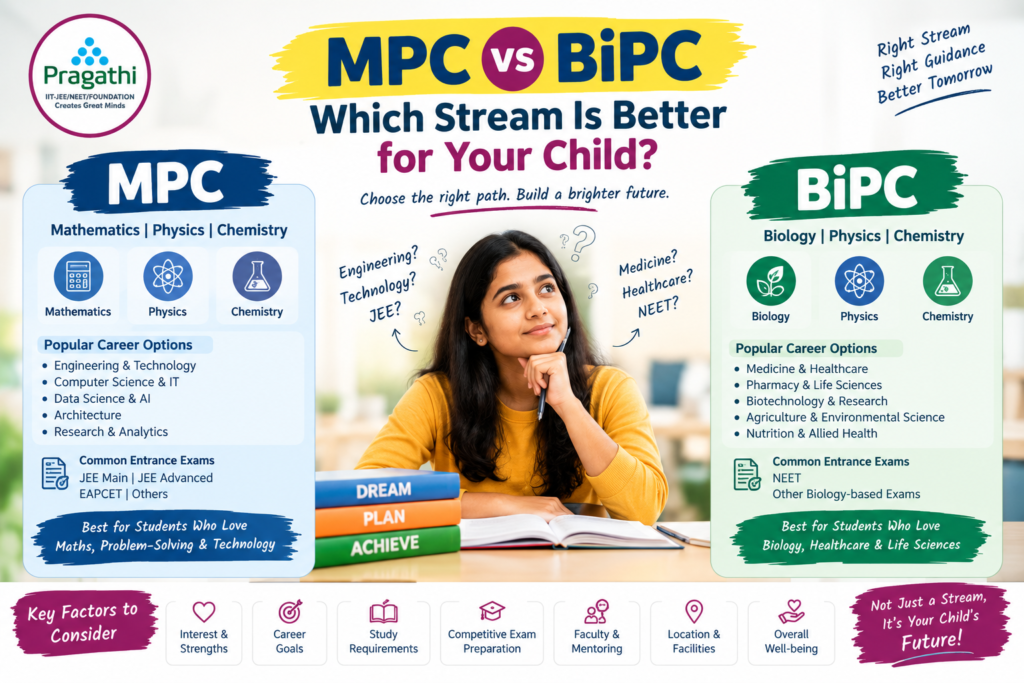
It is a popular Intermediate stream for students interested in engineering, technology, mathematics, architecture, computer-related fields, and other technical careers.
Students choosing MPC often prepare for competitive examinations such as JEE Main, JEE Advanced and EAPCET, depending on their career goals and eligibility.
MPC requires students to develop strong mathematical thinking and problem-solving skills.
Instead of simply memorizing answers, students need to understand concepts and apply them to different types of problems.
Who Is MPC Suitable For?
MPC may be a good choice for students who:
- Enjoy Mathematics
- Like solving numerical problems
- Are interested in Physics
- Enjoy logical reasoning
- Are interested in engineering or technology
- Want to explore computer science
- Are comfortable with analytical thinking
- Enjoy understanding how things work
However, choosing MPC simply because it is considered a “popular” stream is not a good reason.
The student’s interest should come first.
What Is BiPC?
BiPC stands for:
- Biology
- Physics
- Chemistry
BiPC is commonly chosen by students interested in medicine, healthcare, life sciences, pharmacy, biotechnology, agriculture, and other biology-related careers.
Students aiming for medical education often prepare for NEET, while other career paths can have their own entrance requirements.
BiPC requires students to understand biological concepts in depth while also handling Physics and Chemistry.
Who Is BiPC Suitable For?
BiPC may suit students who:
- Enjoy Biology
- Are interested in the human body and life sciences
- Want to explore medicine
- Are interested in healthcare
- Enjoy studying living organisms
- Have good observation and memory skills
- Are comfortable with Chemistry and Physics
- Want to explore biology-related careers
Again, students should not choose BiPC simply because someone says:
“BiPC means you have to become a doctor.”
BiPC offers several career possibilities beyond MBBS.
MPC vs BiPC: The Basic Difference
The biggest difference is the primary subject.
| Factor | MPC | BiPC |
|---|---|---|
| Full Form | Mathematics, Physics, Chemistry | Biology, Physics, Chemistry |
| Major Subject | Mathematics | Biology |
| Suitable For | Engineering, technology, mathematics and technical fields | Medicine, healthcare, life sciences and biology-related fields |
| Common Competitive Exam | JEE, EAPCET and others | NEET and other relevant entrance exams |
| Key Skill | Problem-solving and mathematical reasoning | Conceptual understanding and biological knowledge |
| Learning Style | Numerical + conceptual | Conceptual + theoretical + application |
| Common Career Direction | Engineering & technology | Medicine & healthcare |
The table makes the difference simple, but the actual decision requires more thought.
MPC vs BiPC: Which Is Easier?
This is one of the first questions students ask.
But there is no universal answer.
A student who enjoys Mathematics may find MPC more comfortable.
A student who enjoys Biology may find BiPC more interesting.
For example, if a student dislikes Mathematics but enjoys Biology, forcing them into MPC can make Intermediate unnecessarily difficult.
Similarly, a student who loves Mathematics and wants to pursue engineering may struggle with the decision to choose BiPC simply because it is perceived as a safer option.
The Better Question Is:
“Which subjects does my child enjoy learning consistently?”
Interest does not mean a subject will always be easy. Both streams require discipline and consistent preparation.
MPC Career Options
MPC can open doors to many technical and analytical careers.
Some popular options include:
Engineering
Students can explore areas such as:
- Computer Science Engineering
- Electronics and Communication Engineering
- Mechanical Engineering
- Civil Engineering
- Electrical Engineering
- Aerospace Engineering
- Chemical Engineering
- Artificial Intelligence
- Data Science
Technology Careers
MPC students can also explore:
- Software development
- Artificial intelligence
- Machine learning
- Data analytics
- Cybersecurity
- Cloud computing
- Information technology
Other Options
Depending on eligibility and future education, students may explore:
- Architecture
- Defence-related careers
- Pure sciences
- Mathematics
- Physics
- Research
- Statistics
- Technical fields
The career landscape is much broader than simply saying:
MPC = Engineering.
BiPC Career Options
BiPC is often associated with medicine, but students have many other possibilities.
Medical Careers
Students may explore:
- MBBS
- Dentistry
- Veterinary sciences
- Nursing
- Physiotherapy
- Ayurveda
- Pharmacy
- Allied healthcare fields
Life Science Careers
Students can also explore:
- Biotechnology
- Microbiology
- Biochemistry
- Genetics
- Biomedical sciences
- Life sciences
- Research
Other Biology-Related Fields
Depending on the student’s interests and eligibility, other possibilities can include:
- Agriculture
- Food science
- Nutrition
- Environmental science
- Forensic science
- Healthcare management
Therefore, BiPC does not mean MBBS is the only career option.
What About JEE and NEET?
Competitive examinations are an important part of the MPC vs BiPC decision.
MPC and JEE
Students interested in engineering may prepare for:
- JEE Main
- JEE Advanced
- EAPCET
- Other relevant engineering entrance examinations
JEE preparation requires strong foundations in:
Physics + Chemistry + Mathematics
Students need regular problem-solving practice, conceptual clarity, revision, and mock tests.
BiPC and NEET
Students interested in medical education commonly prepare for:
- NEET
NEET preparation requires strong preparation in:
Physics + Chemistry + Biology
Students need conceptual understanding, extensive practice, revision, and familiarity with the examination pattern.
Which Stream Has More Career Opportunities?
This is another common parent question.
The answer is:
Both MPC and BiPC offer many career opportunities.
The number of opportunities should not be the only factor.
A student may have hundreds of possible career options available, but if they have no interest in the subjects required for that career, the path can become difficult.
Instead of asking:
“Which stream has more opportunities?”
ask:
“Which stream provides opportunities that match my child’s interests and strengths?”
That question leads to a much better decision.
7 Questions Parents Should Ask Before Choosing MPC or BiPC
1. What subjects does my child enjoy?
Ask your child honestly:
- Do you enjoy Mathematics?
- Do you enjoy Biology?
- Do you like Physics?
- Do you enjoy solving numerical problems?
- Do you enjoy learning about living systems?
The answers can provide useful clues.
2. What career does the student currently prefer?
A Class 10 student does not need to have their entire life planned.
But having a broad direction can help.
For example:
Engineering/technology → MPC may be relevant
Medicine/biology/healthcare → BiPC may be relevant
If the student is unsure, parents should explore both options rather than forcing an immediate decision.
3. What are the student’s strengths?
Marks alone should not determine the decision.
Look at:
- Conceptual understanding
- Problem-solving
- Logical thinking
- Memory
- Curiosity
- Interest
- Consistency
A student’s learning pattern can be more useful than one examination result.
4. Is the student ready for competitive-exam preparation?
Both JEE and NEET preparation can require significant effort.
Students should understand that Intermediate academics and competitive-exam preparation may need to be managed together.
Parents should discuss the expected workload before making the decision.
5. What kind of learning does the student enjoy?
MPC often involves substantial numerical and problem-solving practice.
BiPC involves substantial conceptual learning, diagrams, terminology, biological processes, and application.
Neither learning style is automatically better.
The right choice depends on the student.
6. Is the decision coming from the student or the parents?
This is extremely important.
Parents naturally want the best future for their children.
But saying:
“You must become a doctor.”
or
“Engineering has better opportunities, so take MPC.”
without understanding the child’s interests can create unnecessary pressure.
Parents should guide rather than dictate.
7. Has the student researched both streams?
Before finalizing the decision, encourage students to understand:
- Subjects
- Career options
- Entrance exams
- Study requirements
- College options
- Long-term pathways
An informed decision is better than a rushed decision.
Common Mistakes Parents Make While Choosing MPC vs BiPC
Mistake 1: Choosing Based on Friends
Your child’s friend choosing MPC doesn’t mean your child should choose MPC.
Mistake 2: Choosing Based Only on Marks
High marks don’t automatically mean a student will enjoy a particular stream.
Mistake 3: Assuming BiPC Means Only MBBS
BiPC has many career pathways beyond medicine.
Mistake 4: Assuming MPC Means Only Engineering
MPC can lead to technology, research, mathematics, architecture, data-related fields, and many other areas.
Mistake 5: Choosing Based on Social Pressure
Career decisions should not be made simply because relatives or neighbours recommend a particular stream.
Mistake 6: Ignoring Mental Well-Being
A stream should challenge a student without creating constant and unhealthy pressure.
How Parents Can Help Students Make the Right Decision
The best approach is to have an open conversation.
Instead of asking:
“Which stream should you take?”
Try asking:
“What subjects do you enjoy?”
“What kind of career interests you?”
“What do you enjoy doing outside school?”
“Which subjects do you want to learn more about?”
“Would you enjoy solving mathematical problems or studying biology?”
These questions can help students think about their own preferences.
Parents can then research colleges, talk to teachers, and understand the available academic programs.
MPC vs BiPC: Don’t Choose Based on “Better”
The biggest takeaway from the MPC vs BiPC discussion is that there is no single winner.
Choose MPC if:
- Your child enjoys Mathematics.
- They are interested in engineering or technology.
- They enjoy problem-solving.
- They are comfortable with Physics and Chemistry.
- They are interested in JEE or engineering entrance preparation.
Consider BiPC if:
- Your child enjoys Biology.
- They are interested in medicine or healthcare.
- They enjoy life sciences.
- They are interested in NEET.
- They are comfortable studying Biology along with Physics and Chemistry.
The decision should be based on fit, not popularity.
How Pragathi Academy Can Help Students Choose the Right Path
For students and parents looking for structured Intermediate education, Pragathi Academy focuses on academic preparation for students pursuing pathways such as MPC and BiPC.
Students can explore academic programs connected with competitive examinations such as IIT-JEE, NEET and EAPCET, depending on their chosen stream and career direction.
A structured academic environment can help students build subject fundamentals, practice regularly, assess their progress, and prepare for future entrance examinations.
Parents should still evaluate the program based on their child’s individual needs, preferred stream, academic goals, and learning style before making a final admission decision.
Frequently Asked Questions
Is MPC better than BiPC?
No. Neither stream is universally better. MPC may suit students interested in Mathematics, engineering and technology, while BiPC may suit students interested in Biology, medicine, healthcare and life sciences.
Can a BiPC student become an engineer?
Traditional engineering pathways generally require the relevant Mathematics background, so students should check the eligibility requirements of the specific engineering course they want to pursue. Students should research eligibility before choosing their Intermediate subjects.
Is MPC difficult?
MPC can be challenging, particularly for students who are not comfortable with Mathematics and numerical problem-solving. Consistent practice and conceptual understanding are important.
Is BiPC difficult?
BiPC also requires serious preparation. Students need to understand Biology deeply while also studying Physics and Chemistry. Regular revision and practice are important.
Should parents force their child to choose a particular stream?
It is better to guide rather than force. Parents should consider the student’s interests, strengths, career goals and willingness to commit to the chosen subjects.
Can students change their career direction later?
Career plans can evolve. However, subject choices in Intermediate can affect eligibility for certain higher-education pathways. Students should therefore research the prerequisites of careers they are considering before choosing MPC or BiPC.
Final Verdict: MPC vs BiPC
Choosing between MPC vs BiPC is not about finding the stream that is universally better.
It is about finding the stream that is better for your child.
If your child enjoys Mathematics, problem-solving, Physics, and technology, MPC may be worth considering.
If your child enjoys Biology, healthcare, life sciences, and medicine-related subjects, BiPC may be a better fit.
The most important factors are:
Interest + Strengths + Career Goal + Learning Style + Commitment
Don’t choose a stream because everyone else is choosing it.
Don’t choose a stream because a relative recommends it.
And don’t choose a stream only because you believe it has more career opportunities.
Choose the path where your child can learn with interest, work consistently, and build the foundation for the career they want.
The right decision after Class 10 can make the next two years more focused, meaningful, and productive.