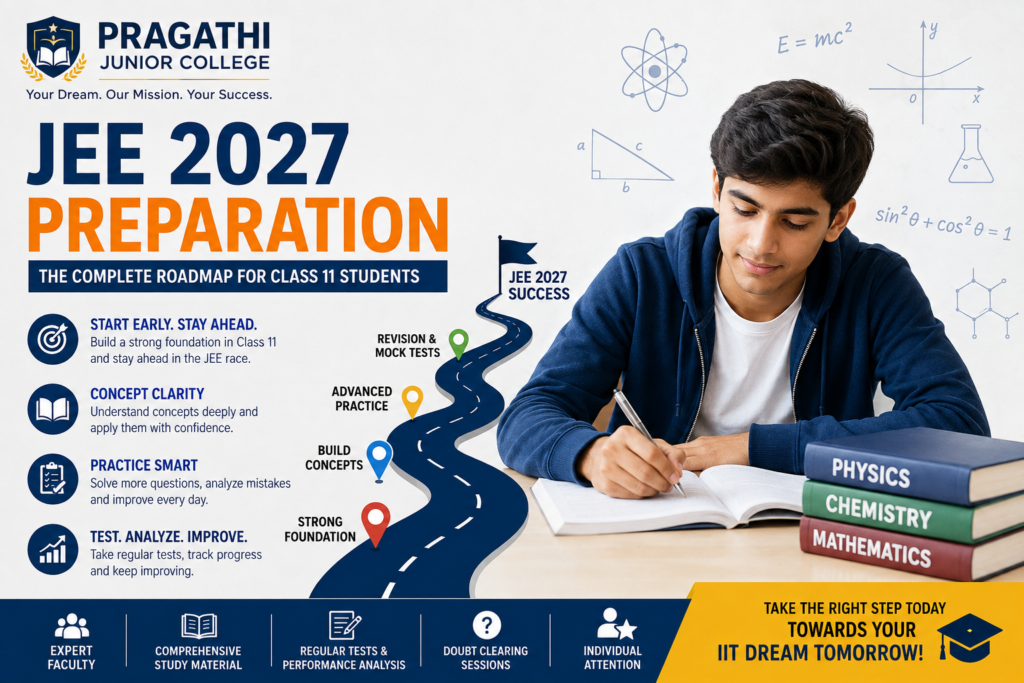
JEE 2027 Preparation: The Complete Roadmap for Class 11 Students
Preparing for JEE 2027 from Class 11 is one of the smartest decisions a student can make if they are aiming for admission to top engineering institutes such as the IITs, NITs, and other reputed colleges. The JEE journey is challenging, but starting early gives students enough time to understand concepts, practice questions, improve speed, and build confidence.
Class 11 is especially important because a major portion of the JEE syllabus comes from Class 11 Physics, Chemistry, and Mathematics. Students who build a strong foundation during these two years can approach JEE Main and JEE Advanced with much greater confidence.
This complete roadmap explains how Class 11 students can start their JEE 2027 preparation, create an effective study schedule, choose the right resources, avoid common mistakes, and stay consistent throughout their preparation.
Why Start JEE 2027 Preparation in Class 11?
Many students begin serious JEE preparation only after entering Class 12. While it is possible to prepare later, starting in Class 11 provides a significant advantage.
The JEE syllabus covers concepts from both Class 11 and Class 12. Therefore, students have approximately two years to study the complete syllabus instead of trying to complete everything in a short period.
Starting in Class 11 helps students:
- Build strong fundamentals in Physics, Chemistry, and Mathematics
- Understand difficult concepts gradually
- Get sufficient time for problem-solving practice
- Identify weak subjects early
- Develop time-management skills
- Take regular mock tests
- Revise multiple times
- Prepare for both JEE Main and JEE Advanced
The goal should not be to study for extremely long hours every day. Instead, students should focus on consistent, focused, and concept-based preparation.
Understand the JEE 2027 Examination
Before starting preparation, students should understand what they are preparing for.
JEE Main is the primary entrance examination for admission to several engineering institutions, including NITs, IIITs, and other participating colleges. It is also the qualifying examination for JEE Advanced.
JEE Advanced is the next level for students who aim for admission to the IITs.
The exact examination pattern, eligibility requirements, dates, and syllabus should always be checked through the official examination authorities because they can change from year to year.
For Class 11 students, the immediate priority should be developing strong knowledge of the subjects rather than worrying too much about the examination itself.
JEE 2027 Preparation Strategy for Class 11
A successful preparation strategy can be divided into different stages.
Stage 1: Build Your Foundation
The first few months of Class 11 should focus heavily on understanding basic concepts.
Do not rush through chapters simply because you want to finish the syllabus quickly. JEE questions often test how well you understand concepts and apply them in unfamiliar situations.
For every chapter:
- Learn the concept.
- Understand important formulas and principles.
- Solve basic questions.
- Move to JEE-level problems.
- Review mistakes.
- Revise the chapter regularly.
If your foundation is strong, advanced problem-solving becomes much easier.
Physics Preparation Strategy
Physics can become one of the most scoring subjects when concepts are understood properly.
Instead of memorizing formulas, try to understand where and why a formula works.
Important Class 11 Physics areas include:
- Units and Measurements
- Kinematics
- Laws of Motion
- Work, Energy and Power
- System of Particles and Rotational Motion
- Gravitation
- Properties of Bulk Matter
- Thermodynamics
- Kinetic Theory
- Oscillations
- Waves
How to Study Physics
Start by understanding the theory and basic principles. Then solve numerical problems of increasing difficulty.
For example, after learning Newton’s Laws of Motion, practice questions involving:
- Free-body diagrams
- Friction
- Connected bodies
- Circular motion
- Inclined planes
- Multiple-force systems
Keep a separate notebook for formulas, important concepts, and mistakes.
Physics requires regular problem-solving. Reading theory without solving questions is not enough for JEE preparation.
Chemistry Preparation Strategy
Chemistry is divided into three major areas:
- Physical Chemistry
- Organic Chemistry
- Inorganic Chemistry
Each requires a slightly different preparation method.
Physical Chemistry
Physical Chemistry involves concepts, formulas, calculations, and numerical problems.
Important areas include:
- Some Basic Concepts of Chemistry
- Atomic Structure
- States of Matter
- Thermodynamics
- Equilibrium
- Redox Reactions
Practice numerical problems regularly and make sure you understand the underlying concepts.
Organic Chemistry
Organic Chemistry becomes much easier when students understand the fundamentals instead of trying to memorize every reaction.
Focus on:
- Basic principles of Organic Chemistry
- Chemical bonding concepts
- Reaction mechanisms
- Hydrocarbons
- Important reactions and their applications
Build your understanding step by step.
Inorganic Chemistry
Inorganic Chemistry requires conceptual understanding as well as regular revision.
Students should pay close attention to:
- Periodic trends
- Chemical bonding
- Classification of elements
- Important properties and reactions
Regular revision is essential because students can easily forget factual information if they do not review it.
Mathematics Preparation Strategy
Mathematics requires consistent practice. Merely watching lectures or reading solutions will not develop the required problem-solving ability.
Important Class 11 areas include:
- Sets and Relations
- Functions
- Quadratic Equations
- Sequences and Series
- Permutations and Combinations
- Binomial Theorem
- Straight Lines
- Circles
- Conic Sections
- Trigonometry
- Complex Numbers
- Limits and Derivatives
- Probability
- Statistics
Start with basic problems and gradually move toward JEE-level questions.
When you get a question wrong, don’t simply look at the answer and move on. Understand exactly where your approach failed.
Create a Realistic Daily Study Schedule
One of the biggest mistakes students make is creating an unrealistic timetable.
Studying for 12–14 hours for two days and then losing consistency for the next week is not an effective strategy.
A better approach is to create a schedule that you can follow every day.
A sample Class 11 JEE preparation schedule could look like this:
| Time | Activity |
|---|---|
| 5:30 AM – 6:00 AM | Wake up and get ready |
| 6:00 AM – 7:00 AM | Formula revision / previous concepts |
| School/College Hours | Classes and academic work |
| 4:30 PM – 5:00 PM | Break and refresh |
| 5:00 PM – 7:00 PM | Physics / Mathematics practice |
| 7:00 PM – 7:30 PM | Break |
| 7:30 PM – 9:00 PM | Chemistry |
| 9:00 PM – 9:30 PM | Dinner |
| 9:30 PM – 10:30 PM | Practice questions / revision |
| 10:30 PM – 10:45 PM | Plan the next day |
The exact timings can be adjusted according to school or college schedules.
The important thing is to maintain a balance between classes, self-study, revision, practice, sleep, and relaxation.
Follow the 3-Step Learning Method
A simple approach for every JEE chapter is:
1. Learn
Understand the concept through your classroom teaching, textbooks, or reliable study material.
2. Practice
Solve questions without immediately looking at the solution.
Start with easy questions and progress toward difficult JEE-level problems.
3. Revise
Revision should happen regularly.
A useful revision cycle can be:
- Same day
- After 2–3 days
- After one week
- After one month
This helps move information from short-term understanding to long-term memory.
The Importance of NCERT
NCERT textbooks are particularly important for Chemistry and should not be ignored.
Students should read the relevant NCERT chapters carefully and understand the concepts, definitions, reactions, tables, and examples.
For Physics and Mathematics, students can use NCERT as a foundation and then move to appropriate JEE-level practice material.
The key is not to collect too many books.
Using a limited number of reliable resources consistently is generally better than buying multiple books and leaving most of them incomplete.
Solve Previous-Year Questions
Previous-year JEE questions are among the most useful resources for understanding the examination.
They help students identify:
- Frequently tested concepts
- Question difficulty
- Application-based problems
- Common patterns
- Time requirements
Class 11 students do not need to solve every advanced-level question immediately.
First, complete the relevant chapter and understand the concepts. Then gradually introduce previous-year questions into your practice.
Take Regular Tests
Tests should be part of JEE preparation from an early stage.
Initially, students can take chapter-wise tests.
Later, move to:
- Part-syllabus tests
- Full-syllabus tests
- JEE Main-style tests
- JEE Advanced-style practice
After every test, spend time analyzing your performance.
Ask yourself:
- Which questions did I get wrong?
- Was the mistake conceptual or careless?
- Did I spend too much time on a question?
- Which topics need revision?
- Which subject needs more attention?
A test is valuable only when you learn from your mistakes.
Maintain a Mistake Notebook
A mistake notebook can become one of the most useful tools during JEE preparation.
Whenever you make an important mistake, record:
- The question or concept
- Your incorrect approach
- The correct approach
- The reason for your mistake
- The key lesson
Review this notebook regularly.
Over time, you will notice patterns in your mistakes. This allows you to work specifically on your weaknesses.
How to Manage School and JEE Preparation
Class 11 students often worry about managing board academics and JEE preparation simultaneously.
The good news is that there is considerable overlap between school-level PCM concepts and JEE preparation.
Instead of treating them as completely separate studies, try to understand the concepts at the JEE level while ensuring that your school syllabus is also covered.
A structured junior college or coaching environment can help students maintain this balance by providing:
- Regular classes
- Academic monitoring
- Study material
- Doubt-clearing sessions
- Tests
- Performance analysis
- Revision schedules
Common Mistakes to Avoid During JEE Preparation
1. Studying Without a Plan
Jumping between chapters without a structured schedule can create confusion.
Create weekly and monthly targets.
2. Ignoring Class 11 Topics
Students sometimes assume that they can study Class 11 chapters later.
This can create significant pressure in Class 12.
Complete Class 11 topics properly before moving ahead.
3. Memorizing Instead of Understanding
JEE requires application of concepts.
Try to understand the logic behind formulas, reactions, and mathematical methods.
4. Using Too Many Resources
More books do not automatically mean better preparation.
Choose reliable resources and complete them thoroughly.
5. Avoiding Difficult Questions
Difficult questions are an opportunity to improve.
If you cannot solve a problem, study the solution carefully and try a similar question afterward.
6. Ignoring Revision
Learning a chapter once is not enough.
Regular revision is necessary to retain concepts.
7. Neglecting Sleep and Health
JEE preparation is a long-term journey.
Students should maintain proper sleep, nutrition, physical activity, and short breaks.
A tired mind cannot perform at its best.
A Month-by-Month JEE 2027 Roadmap
A broad Class 11 roadmap can look like this:
Early Class 11
Focus on:
- Understanding the fundamentals
- Developing study habits
- Completing initial chapters
- Building mathematical skills
- Creating proper notes
Middle of Class 11
Focus on:
- Increasing problem-solving difficulty
- Regular chapter tests
- Previous-year questions
- Identifying weak areas
- Consistent revision
End of Class 11
Focus on:
- Completing remaining Class 11 syllabus
- Revising important chapters
- Taking part-syllabus tests
- Improving speed and accuracy
- Strengthening weak concepts
Beginning of Class 12
Class 11 revision should continue alongside Class 12 preparation.
Avoid completely forgetting Class 11 topics while moving forward.
Middle of Class 12
Start combining Class 11 and Class 12 topics through mixed tests.
Final Phase
Focus on:
- Full-syllabus revision
- Mock tests
- Previous-year papers
- Time management
- Accuracy
- Weak-topic revision
How Pragathi Junior College Can Support JEE Aspirants
Choosing the right academic environment can make a significant difference during JEE preparation.
Pragathi Junior College provides an academic environment designed to help intermediate students work toward competitive examinations while continuing their regular studies.
For JEE aspirants, the right learning environment should encourage conceptual understanding, regular practice, doubt clarification, testing, and continuous improvement.
Students and parents should evaluate factors such as faculty support, academic planning, study material, test systems, doubt-solving facilities, and individual student guidance before choosing a junior college or coaching program.
Final Thoughts
JEE 2027 preparation is not about studying everything in one month or trying to become a topper overnight. It is a two-year journey that requires patience, consistency, discipline, and smart planning.
For Class 11 students, the best time to start is now. Build your concepts carefully, practice questions every day, revise regularly, analyze your tests, and learn from your mistakes.
Remember that consistency is more important than occasional long study sessions.
With a strong foundation in Physics, Chemistry, and Mathematics and the right academic guidance, students can steadily move toward their JEE goals.
If you are looking for a structured JEE preparation program for Class 11 in Hyderabad, explore the academic programs and admission options available at Pragathi Junior College and choose a learning path that matches your engineering goals.
Frequently Asked Questions
1. When should I start preparing for JEE 2027?
Class 11 is an ideal time to begin. Starting early gives you sufficient time to understand the syllabus, practice questions, revise concepts, and prepare for both JEE Main and JEE Advanced.
2. Is Class 11 important for JEE preparation?
Yes. Class 11 covers several important Physics, Chemistry, and Mathematics concepts that form the foundation for Class 12 and JEE-level preparation.
3. How many hours should a Class 11 student study for JEE?
There is no fixed number that works for everyone. Focus on consistent, distraction-free study and balance JEE preparation with college, sleep, and other responsibilities.
4. Should I focus on JEE Main or JEE Advanced in Class 11?
Build your concepts with both examinations in mind. Strong fundamentals and problem-solving skills will help with JEE Main as well as the more challenging JEE Advanced questions.
5. Are NCERT books enough for JEE?
NCERT is extremely important, particularly for Chemistry, but JEE preparation generally requires additional problem-solving practice and suitable competitive-exam resources.
6. How can I improve my JEE preparation?
Follow a structured study plan, understand concepts thoroughly, solve questions regularly, take mock tests, analyze mistakes, and revise consistently.
Start your JEE 2027 journey in Class 11 with the right plan, the right guidance, and consistent effort. Your preparation today can build the foundation for your engineering career tomorrow.