
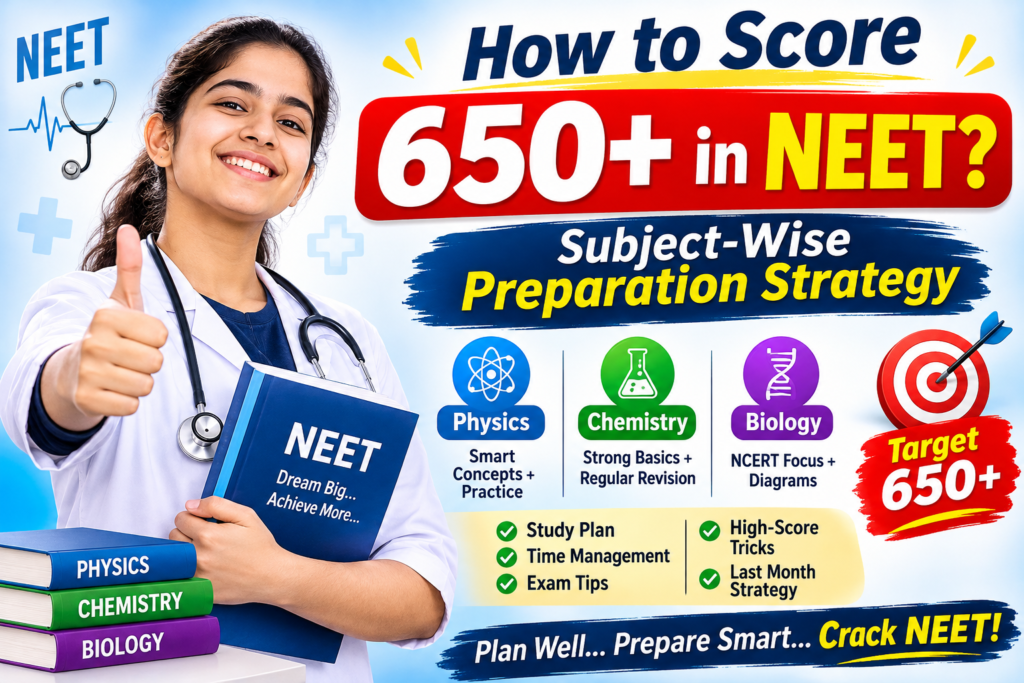
Introduction
Scoring 650+ marks in the National Eligibility cum Entrance Test (NEET) is an important goal for students aspiring to secure admission to top medical colleges in India. However, achieving this target requires more than simply studying for long hours. Students need a well-planned preparation strategy, a clear understanding of concepts, regular practice and consistent revision.
NEET is a competitive medical entrance examination that tests students in Physics, Chemistry and Biology. Each subject requires a different preparation approach. While Biology demands strong NCERT knowledge and accurate recall, Physics requires conceptual understanding and numerical practice. Chemistry needs a balanced combination of theory, problem-solving and memorisation.
For Intermediate BiPC students, starting preparation early and following a structured timetable can make a significant difference.
In this guide, we explain how to score 650+ in NEET through a subject-wise preparation strategy, effective time management, mock tests and revision techniques.
1. Understand the NEET Exam Pattern
Before beginning preparation, students should understand the examination structure and marking scheme.
Under the current NEET-UG pattern, the examination has:
- Total questions: 180 compulsory questions.
- Physics: 45 questions.
- Chemistry: 45 questions.
- Biology: 90 questions.
- Total marks: 720.
- Correct answer: +4 marks.
- Incorrect answer: -1 mark.
- Unanswered question: 0 marks.
Biology carries 360 marks, while Physics and Chemistry carry 180 marks each. Therefore, students should give special attention to Biology while maintaining balanced preparation across all three subjects.
Always check the latest official NTA information bulletin for the applicable examination pattern and syllabus.
2. Subject-Wise Preparation Strategy to Score 650+
A. Biology Preparation Strategy – Target: 340–350 Marks
High-priority subject
Biology is one of the most important subjects for NEET aspirants because it contributes 50% of the total marks. Students aiming for 650+ should develop strong command over both Botany and Zoology.
Important preparation tips:
- Read NCERT thoroughly: Study every chapter from Class 11 and Class 12 NCERT Biology textbooks. Pay attention to diagrams, tables, definitions and examples.
- Understand important concepts: Focus on Human Physiology, Genetics, Ecology, Plant Physiology, Biotechnology and Reproduction.
- Practice MCQs daily: Solve at least 80–100 Biology questions regularly, adjusting the number based on your study schedule.
- Revise diagrams: Practice labelled diagrams and understand their associated concepts.
- Prepare short notes: Maintain separate notes for scientific names, biological processes, important examples and confusing concepts.
- Take chapter-wise tests: Identify weak chapters and revise them before moving to full-length tests.
Pro tip: Read NCERT Biology repeatedly instead of depending on too many reference books. Understanding every important NCERT line can help improve accuracy.
B. Chemistry Preparation Strategy – Target: 160–170 Marks
Chemistry requires a combination of conceptual learning, numerical practice and memorisation. Divide the subject into Physical, Organic and Inorganic Chemistry.
Physical Chemistry
- Understand fundamental concepts and formulas.
- Practice numerical problems every day.
- Focus on Chemical Kinetics, Thermodynamics, Equilibrium and Electrochemistry.
- Maintain a separate formula notebook.
- Solve previous years’ NEET questions.
Organic Chemistry
- Build a strong foundation in General Organic Chemistry (GOC).
- Understand reaction mechanisms instead of memorising reactions blindly.
- Practice named reactions and conversions.
- Focus on hydrocarbons, carbonyl compounds, amines and other syllabus-relevant chapters.
- Revise important reactions regularly.
Inorganic Chemistry
- Study NCERT carefully.
- Memorise important chemical properties, trends and reactions.
- Create comparison tables for periodic properties.
- Revise coordination compounds and other prescribed chapters.
- Solve topic-wise MCQs.
Pro tip: Spend time understanding the concepts first, then move to MCQ practice. Regular revision is especially important for Inorganic and Organic Chemistry.
C. Physics Preparation Strategy – Target: 150–160 Marks
Physics is challenging for many NEET aspirants because it involves conceptual understanding and numerical problem-solving. Students should focus on developing accuracy and calculation speed.
Important preparation tips:
- Build strong fundamentals: Understand basic concepts, laws and formulas before attempting difficult problems.
- Practice numerical questions: Solve approximately 30–50 questions daily, depending on your preparation level.
- Focus on important chapters: Mechanics, Current Electricity, Electrostatics, Optics, Modern Physics, Thermodynamics and Magnetism.
- Maintain a formula notebook: Write important formulas with their applications and units.
- Solve previous years’ questions: Understand question patterns and frequently tested concepts.
- Analyse mistakes: Identify whether errors occur due to calculation, conceptual understanding or time management.
Pro tip: Do not simply memorise formulas. Understand when and how to apply them in different numerical problems.
3. Follow a Daily NEET Study Timetable
A disciplined timetable helps students cover the complete NEET syllabus without unnecessary stress. Students should divide their study hours between learning new concepts, practising questions and revising previously studied topics.
Here is a sample daily timetable:
| Time | Activity |
|---|---|
| 5:30 AM – 7:00 AM | Biology NCERT revision |
| 7:00 AM – 8:00 AM | Breakfast and preparation |
| 8:00 AM – 2:00 PM | Intermediate classes and coaching |
| 2:00 PM – 3:00 PM | Lunch and rest |
| 3:00 PM – 4:30 PM | Physics concepts and numericals |
| 4:30 PM – 5:00 PM | Short break |
| 5:00 PM – 6:30 PM | Chemistry preparation |
| 6:30 PM – 7:30 PM | Biology MCQ practice |
| 7:30 PM – 8:30 PM | Dinner and relaxation |
| 8:30 PM – 9:30 PM | Revision and previous years’ questions |
Students can adjust this timetable according to their school or college schedule. Consistency is more important than studying continuously without breaks.
4. Solve Previous Years’ NEET Question Papers
Previous years’ question papers are valuable resources for understanding examination trends and improving problem-solving skills.
Students should:
- Solve previous 10–15 years’ question papers where relevant.
- Practise chapter-wise questions after completing each topic.
- Identify frequently tested concepts.
- Attempt questions within a fixed time limit.
- Review incorrect and unanswered questions.
Solving previous papers also helps students become familiar with the actual examination environment.
5. Take Regular Mock Tests and Analyse Performance
Mock tests are essential for students targeting 650+ marks in NEET. They help evaluate preparation levels and identify areas that need improvement.
After every mock test, analyse:
- Which questions were answered incorrectly?
- Which topics took too much time?
- Were marks lost because of negative marking?
- Which chapters need additional revision?
- Was the examination time managed effectively?
Maintain a mistake notebook and record repeated errors. Revise these mistakes before attempting the next mock test.
As the examination approaches, students should gradually increase the frequency of full-length tests under timed conditions.
6. Create an Effective Revision Strategy
Revision is one of the most important factors in NEET preparation. Studying a chapter once is not enough to remember it during the examination.
Follow a simple revision cycle:
- Daily revision: Review concepts studied during the day.
- Weekly revision: Revisit all important topics covered during the week.
- Monthly revision: Attempt chapter-wise and cumulative tests.
- Final revision: Concentrate on NCERT, formulas, reactions, diagrams and frequently made mistakes.
Avoid collecting too many study materials. Stick to reliable textbooks, class notes and quality question banks.
7. Common Mistakes NEET Aspirants Should Avoid
Even hardworking students sometimes lose marks because of poor preparation habits.
Avoid these common mistakes:
- Ignoring NCERT textbooks.
- Spending too much time on one difficult chapter.
- Memorising Physics formulas without understanding concepts.
- Neglecting Chemistry revision.
- Studying without a proper timetable.
- Avoiding mock tests due to fear of low scores.
- Using too many reference books.
- Not analysing incorrect answers.
- Sacrificing sleep and physical well-being.
Remember that consistent preparation and smart revision are more effective than last-minute studying.
8. How Can the Right Junior College Support NEET Preparation?
Choosing the right Intermediate college is an important decision for students planning a medical career.
A suitable educational environment can help students balance their Intermediate board examinations and NEET preparation.
When selecting a junior college, parents and students should consider:
- Experienced subject faculty.
- Structured academic planning.
- Regular examinations and assessments.
- Concept-based teaching methods.
- Doubt-clearing sessions.
- Individual academic guidance.
- A supportive learning environment.
Pragathi Academy offers educational programmes for students aspiring to pursue competitive examinations and higher education. Students interested in BiPC and NEET preparation can explore the available academic programmes and admission options.
Choosing an institution that supports both academic learning and entrance examination preparation can help students work towards their medical career goals.
9. Frequently Asked Questions About Scoring 650+ in NEET
Q1. Is it possible to score 650+ in NEET in one year?
Yes. Students can work towards 650+ within one year with a structured study plan, strong NCERT preparation, regular MCQ practice and consistent mock tests. Results depend on the student’s starting level and preparation consistency.
Q2. How many hours should I study daily for NEET?
Students should create a realistic study schedule that allows sufficient time for all three subjects. Around 6–8 focused self-study hours, in addition to classes, can be a useful target for many aspirants.
Q3. Which subject is most important for scoring 650+ in NEET?
Biology carries 360 out of 720 marks, making it particularly important. However, students must also prepare Physics and Chemistry seriously to achieve a high overall score.
Q4. Is NCERT enough for NEET preparation?
NCERT is the foundation of NEET preparation, particularly for Biology and Inorganic Chemistry. Students should also practise numerical problems, conceptual questions and previous years’ questions.
Q5. When should students start preparing for NEET?
Ideally, students should begin preparing from Intermediate First Year (Class 11). Starting early provides sufficient time to understand concepts, practise questions and revise the complete syllabus.
Conclusion
Scoring 650+ in NEET is an achievable preparation goal for students who follow a disciplined and consistent approach. Success requires a combination of strong Biology preparation, conceptual understanding in Physics, thorough Chemistry revision and regular mock examinations.
Students should focus on NCERT textbooks, practise previous years’ questions, identify their weaknesses and improve their accuracy through continuous testing.
Most importantly, avoid comparing your preparation journey with others. Set realistic daily targets, stay motivated and work consistently towards your medical career aspirations.
Your journey towards becoming a doctor starts with the right preparation today!
At Pragathi Academy, students can explore academic programmes designed to support their Intermediate education and competitive examination aspirations. Take the first step towards your medical career with focused learning and dedicated preparation.