
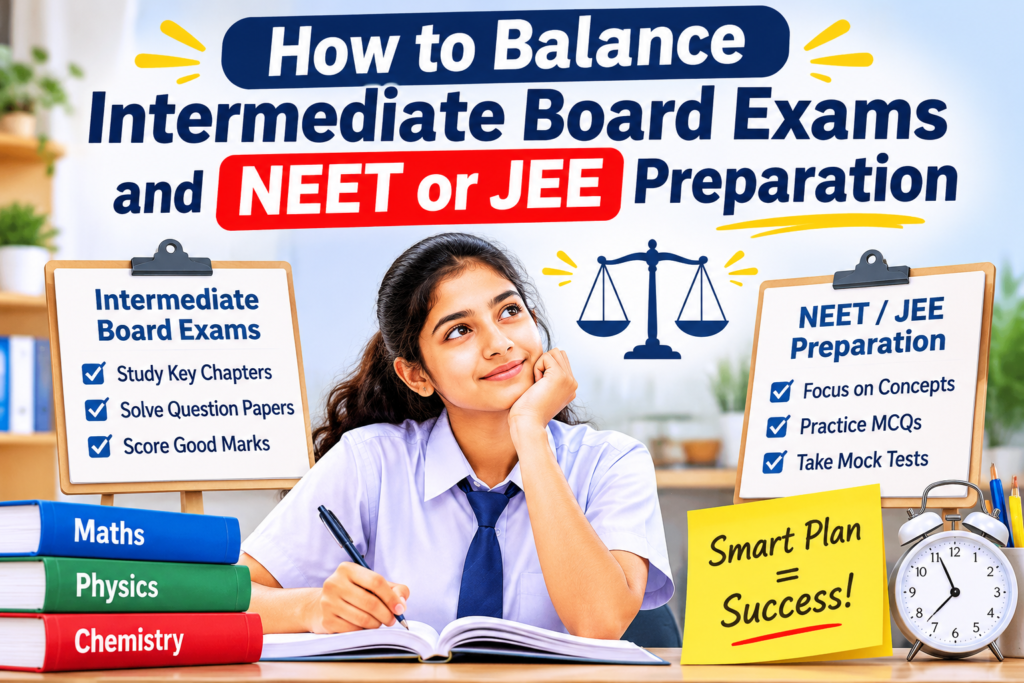
NEET 2027 Preparation Strategy: A Complete Guide for Class 11 and 12 Students
Preparing for Intermediate board exams while studying for NEET or JEE can feel challenging for many students. Both require a strong understanding of Physics, Chemistry and other subjects, regular revision, and consistent practice. With the right strategy, however, students can prepare for board examinations and competitive entrance tests without feeling overwhelmed.
For students aiming to become doctors, engineers or other professionals, the key is to study smartly rather than simply study for longer hours. A structured timetable, clear priorities, regular mock tests and effective revision can make preparation more manageable.
At Pragathi Academy, students can learn the importance of building strong academic fundamentals, developing disciplined study habits and preparing systematically for their educational goals.
1. Understand the Difference Between Board Exams and NEET or JEE
The first step is understanding how board examinations differ from competitive entrance exams.
Intermediate board examinations generally assess conceptual understanding, written answers, derivations, explanations and problem-solving according to the prescribed syllabus and examination pattern.
NEET primarily tests students’ understanding of Physics, Chemistry and Biology through multiple-choice questions. JEE Main tests Physics, Chemistry and Mathematics, with a focus on conceptual clarity, application and numerical problem-solving.
Although the examination formats differ, the subjects share many concepts. This overlap allows students to prepare for both simultaneously.
What should you do?
- Study textbook concepts thoroughly before moving to advanced questions.
- Practise writing structured answers for board examinations.
- Solve multiple-choice questions to improve competitive exam readiness.
- Identify topics that are important for both examinations.
Building strong fundamentals first helps students reduce unnecessary repetition.
2. Create a Realistic Daily Study Timetable
A practical study timetable is one of the most effective ways to balance board exams and NEET or JEE preparation. Instead of studying randomly, divide your available time between learning new concepts, revision, question practice and rest.
Students attending college or coaching classes should create a timetable that fits their actual daily schedule.
For example, a student with several hours available outside classes might follow this routine:
| Time | Activity |
|---|---|
| 6:00–7:00 AM | Revise previously studied concepts |
| College hours | Attend classes and make notes |
| 4:00–5:00 PM | Review college lessons and board topics |
| 5:00–6:30 PM | NEET or JEE question practice |
| 7:30–8:30 PM | Study a difficult subject |
| 8:30–9:00 PM | Quick revision and error review |
This is only an example. Students should adjust the schedule according to their classes, commute, energy levels and examination dates.
Consistency is more valuable than following an unrealistic timetable for a few days and abandoning it later.
3. Prioritise the Common Syllabus
One major advantage of preparing for Intermediate board examinations and competitive entrance tests together is the overlap in the syllabus.
For example, Physics and Chemistry concepts studied in Intermediate can also support NEET and JEE preparation. However, the depth of practice and the examination approach may differ.
Use a three-step approach:
Step 1: Learn the concept. Understand the theory, definitions, formulas and underlying principles.
Step 2: Prepare for board examinations. Practise derivations, descriptive answers, diagrams and textbook questions where applicable.
Step 3: Practise entrance questions. Solve NEET or JEE-style multiple-choice questions and numerical problems related to the same concept.
This method allows you to revise a topic while preparing for different examination formats. It also helps you identify gaps in understanding before they become major problems.
4. Follow NCERT and Your Prescribed Board Textbooks
Textbooks should form the foundation of your preparation. Students often collect too many reference books and online resources, making it difficult to complete the essential syllabus.
For NEET aspirants, NCERT Biology, Chemistry and relevant Physics concepts are particularly important. JEE aspirants should build a solid conceptual foundation using their prescribed textbooks and suitable problem-solving resources.
For Intermediate board examinations, follow the current syllabus and examination guidelines issued by your respective board.
A useful strategy is to complete textbook learning first, practise relevant examples and exercises, and then use additional materials to strengthen weak areas.
Avoid switching between multiple books for the same topic unless you have a specific learning requirement.
5. Practise Previous Papers and Mock Tests
Regular practice helps students understand question patterns, improve accuracy and manage examination time.
For board exams, solve previous question papers and practise writing complete answers within the allotted time. Pay attention to presentation, step-by-step calculations, diagrams and the marks assigned to each question.
For NEET and JEE, take timed mock tests and practise questions from relevant chapters. After every test, review your performance rather than focusing only on your score.
Ask yourself:
- Which concepts did I misunderstand?
- Did I make calculation or reading errors?
- Which questions took too much time?
- Which topics need additional revision?
Maintain an error notebook and revisit it every week. Correcting repeated mistakes can improve performance more effectively than solving large numbers of questions without reviewing them.
6. Use Weekly Revision to Remember More
Studying a chapter once does not guarantee that you will remember it during an examination. Regular revision helps reinforce concepts and makes recall easier.
Divide your weekly revision into three categories:
- Strong topics: Revise briefly and practise selected questions.
- Average topics: Review notes and solve additional problems.
- Weak topics: Relearn concepts, ask questions and practise from the basics.
Use short notes, formula sheets, flashcards and chapter summaries where helpful. Biology students can revise important terminology, diagrams and factual concepts. Physics and Mathematics students can maintain formula lists and review problem-solving methods. Chemistry students can organise reactions, formulas and important concepts systematically.
A short daily revision session can prevent the need to relearn entire chapters immediately before examinations.
7. Manage Time According to Examination Priorities
Your preparation strategy should change as examination dates approach.
During the early months, focus on understanding concepts and completing the syllabus. As examinations get closer, increase revision, timed practice and previous-paper solving.
When Intermediate board exams are approaching, give sufficient time to board-specific preparation, including written answers and practical examination requirements. Continue shorter competitive exam practice sessions to maintain continuity, where appropriate.
After board examinations, use the available time for focused NEET or JEE revision and mock tests, depending on the official examination schedule.
Always check the latest official notifications for examination dates, eligibility requirements and syllabus updates. Do not assume that every year follows the same timetable.
8. Avoid Common Preparation Mistakes
Even hardworking students can struggle when their study methods are ineffective.
Avoid these common mistakes:
Studying without a plan: Decide what you will complete each day instead of choosing topics randomly.
Ignoring difficult subjects: Allocate extra time to weak areas instead of repeatedly studying only familiar chapters.
Skipping sleep: Adequate sleep supports concentration, memory and learning. Avoid making all-night study sessions a regular habit.
Comparing yourself with others: Focus on your own progress, accuracy and understanding.
Ignoring board examinations: Competitive exam preparation should not come at the expense of essential Intermediate coursework.
Taking mock tests without analysis: Review incorrect answers and revise the underlying concepts after every test.
Balanced preparation requires consistency, patience and the willingness to improve your methods.
9. Take Care of Your Physical and Mental Well-Being
Long preparation periods can be stressful. Students should include adequate sleep, nutritious meals, short breaks and regular physical activity in their routines.
Break large goals into smaller daily tasks. Completing a chapter, improving test accuracy or correcting a recurring mistake can provide a sense of progress.
If you feel persistently overwhelmed, discuss your difficulties with a teacher, parent or academic counsellor. Asking for help is a sensible step toward better preparation.
Remember that sustainable study habits are more useful than exhausting yourself for a few days.
10. Choose the Right Academic Guidance
Good academic guidance can help students understand difficult concepts, identify weak areas and maintain a consistent preparation schedule.
When choosing a junior college or coaching programme, consider faculty experience, syllabus coverage, doubt-clearing support, practice tests, individual attention and the balance between board examinations and competitive preparation.
Students should also check the actual course structure, teaching schedule and available facilities before making an admission decision.
At Pragathi Academy, students and parents can explore the available Intermediate and entrance-exam preparation options to determine which programme suits their academic goals. Choose a learning environment that encourages conceptual understanding, regular practice and steady improvement.
Conclusion
Balancing Intermediate board exams with NEET or JEE preparation becomes easier when students follow a structured timetable, focus on common concepts, practise examination-specific questions and revise consistently.
Start with strong fundamentals, use textbooks effectively, analyse mock tests and give yourself enough time to rest. Adjust your priorities as examinations approach rather than trying to study everything at once.
With disciplined effort and appropriate academic guidance, students can work towards their board examination goals while building the knowledge and problem-solving skills needed for competitive entrance tests.
Planning your Intermediate journey? Explore Pragathi Academy’s available academic programmes and choose a preparation plan that aligns with your goals.
Frequently Asked Questions
1. Can I prepare for Intermediate board exams and NEET or JEE together?
Yes. Many subjects and concepts overlap. A structured timetable that includes textbook learning, board-specific practice and competitive exam questions can help students prepare for both.
2. How many hours should I study daily for NEET or JEE along with Intermediate?
There is no single ideal number of hours for every student. Your study time should depend on college hours, current preparation level, syllabus completion and upcoming examinations. Focus on productive, consistent study rather than hours alone.
3. Is NCERT enough for NEET preparation?
NCERT is especially important for NEET, particularly Biology and Chemistry. Students should also practise relevant questions, review weak concepts and take mock tests according to the current syllabus and examination pattern.
4. How can I manage board exams and JEE Mathematics?
Study the underlying concepts, practise textbook exercises and gradually solve JEE-level problems. Maintain a formula notebook, review calculation mistakes and take timed practice tests.
5. When should I start preparing for NEET or JEE?
Starting in Class 11 allows students to build fundamentals over time. However, the best plan depends on your current level, remaining syllabus and examination schedule. Begin with a realistic routine and revise regularly.