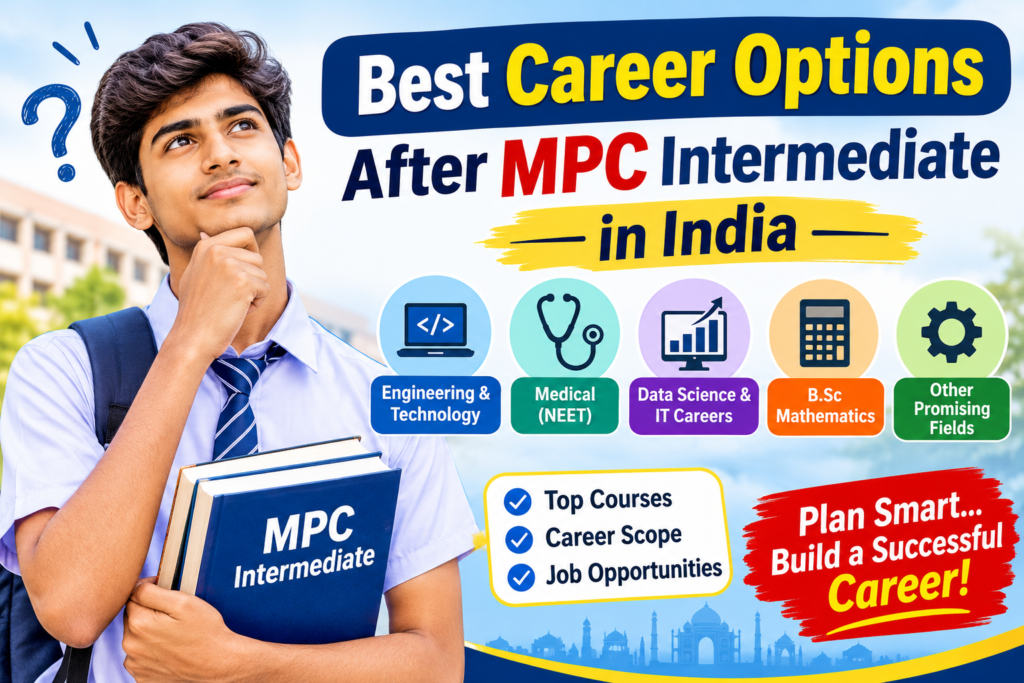
Choosing the right career after completing Intermediate can be an important decision for every student. Students who select the Mathematics, Physics, and Chemistry (MPC) stream have numerous career opportunities in engineering, technology, science, architecture, defence, and other professional fields. With the right guidance and preparation, MPC students can build successful careers in India and abroad.
If you have completed or are planning to pursue MPC Intermediate, understanding the available courses, entrance examinations, and career opportunities can help you make an informed decision.
In this guide, we explore the best career options after MPC Intermediate in India, popular professional courses, and tips for choosing the right career path.
What Is MPC in Intermediate?
MPC stands for Mathematics, Physics, and Chemistry. It is one of the most popular Intermediate streams for students interested in mathematics, engineering, technology, and scientific fields.
The MPC combination develops analytical thinking, logical reasoning, problem-solving abilities, and scientific knowledge. These skills are useful across several industries, making MPC a flexible academic choice.
After completing MPC, students can pursue undergraduate degrees, professional courses, diploma programs, and competitive examinations based on their interests and eligibility.
1. Engineering (B.Tech / B.E.)
Engineering is one of the most popular career choices after MPC Intermediate. Students interested in technology, innovation, machines, software, and infrastructure can consider different engineering specializations.
Popular engineering branches include:
- Computer Science Engineering (CSE)
- Artificial Intelligence and Machine Learning
- Information Technology (IT)
- Mechanical Engineering
- Civil Engineering
- Electronics and Communication Engineering (ECE)
- Electrical and Electronics Engineering (EEE)
- Data Science and Cybersecurity
Students can gain admission through entrance examinations such as JEE Main, JEE Advanced, and state-level engineering entrance examinations, depending on the institution.
Career opportunities: Software Engineer, Mechanical Engineer, Civil Engineer, Data Analyst, AI Engineer, and Electronics Engineer.
2. Computer Science and Information Technology
The IT industry offers excellent opportunities for students interested in computers, programming, and digital technologies.
Students can choose courses such as:
- B.Tech in Computer Science
- B.Sc. Computer Science
- BCA (where eligibility requirements are met)
- B.Sc. Information Technology
- B.Tech in Artificial Intelligence
- B.Tech in Cybersecurity
These programs introduce students to programming languages, databases, software development, computer networks, and emerging technologies.
Career opportunities: Software Developer, Web Developer, Application Developer, Cybersecurity Analyst, and Database Administrator.
3. Architecture (B.Arch)
Architecture is an excellent option for students who enjoy creativity, mathematics, design, and construction.
The Bachelor of Architecture (B.Arch) program focuses on building design, planning, construction technology, architectural drawing, and sustainable development.
Admission requirements may include qualifying entrance examinations such as NATA or JEE Main Paper 2, depending on the admission route and applicable rules.
Career opportunities: Architect, Interior Design Professional, Urban Planner, Architectural Consultant, and Building Design Specialist.
4. Bachelor of Science (B.Sc.)
Students interested in scientific research, mathematics, technology, and academic careers can choose a Bachelor of Science degree.
Popular B.Sc. specializations include:
- B.Sc. Mathematics
- B.Sc. Physics
- B.Sc. Chemistry
- B.Sc. Statistics
- B.Sc. Computer Science
- B.Sc. Data Science
These courses help students develop subject knowledge and research skills. Graduates can pursue postgraduate education, research opportunities, teaching careers, or industry-specific roles.
Career opportunities: Research Assistant, Data Analyst, Laboratory Professional, Statistician, and Science Educator.
5. Defence Services
Students who are interested in serving the nation can explore defence career opportunities after MPC Intermediate.
The National Defence Academy (NDA) examination conducted by UPSC provides an entry route into the Army, Navy, and Air Force, subject to the respective eligibility requirements.
For Air Force and Naval wings, candidates generally need to have studied Physics, Chemistry, and Mathematics at the required level.
Students should prepare for written examinations, physical fitness assessments, medical examinations, and the Services Selection Board (SSB) process.
Career opportunities: Commissioned Officer in the Indian Army, Navy, or Air Force.
6. Aviation and Aeronautical Courses
Aviation is another interesting career field for students with an MPC background.
Students can explore programs such as:
- B.Sc. Aviation
- B.Tech Aeronautical Engineering
- B.Tech Aerospace Engineering
- Aircraft Maintenance Engineering (AME)
- Commercial Pilot Training
Each program has different admission and licensing requirements. Students interested in becoming commercial pilots should check the applicable medical, educational, and licensing requirements before enrolling.
Career opportunities: Pilot, Aerospace Engineer, Aircraft Maintenance Professional, and Aviation Operations Specialist.
7. Data Science and Artificial Intelligence
Artificial Intelligence and Data Science are growing technology fields that offer opportunities across healthcare, banking, education, manufacturing, and software industries.
MPC students with strong mathematical and analytical skills can consider degrees such as B.Tech in AI and Machine Learning, B.Tech in Data Science, or relevant B.Sc. programs.
Students can develop skills in Python programming, statistics, machine learning, data visualization, and problem-solving.
Career opportunities: Data Scientist, Machine Learning Engineer, AI Developer, Business Intelligence Analyst, and Data Engineer.
8. Mathematics, Statistics and Finance
Students who enjoy calculations, numbers, and analytical problem-solving can consider careers in mathematics, statistics, economics, and finance.
Popular academic options include B.Sc. Mathematics, B.Sc. Statistics, B.A. Economics, and other eligible quantitative programs.
Students can also explore professional qualifications such as actuarial science, subject to their admission and examination requirements.
Career opportunities: Financial Analyst, Actuarial Professional, Statistician, Risk Analyst, and Quantitative Analyst.
9. Other Professional and Emerging Career Options
Apart from traditional engineering and science courses, MPC students can explore several other career paths based on their interests and eligibility.
Some options include:
- B.Des (Design)
- BBA (Business Administration)
- BCA (Computer Applications)
- Environmental Science
- Robotics and Automation
- Renewable Energy Technology
- Commercial and professional aviation courses
Students should check the specific eligibility requirements of each college before applying.
How to Choose the Right Career After MPC?
Selecting a career should not depend only on popularity or salary expectations. Students should consider their interests, abilities, long-term goals, and financial circumstances.
Here are some important factors to consider:
1. Identify Your Interests: Understand whether you enjoy technology, mathematics, science, design, business, or defence services.
2. Understand Your Strengths: Evaluate your performance in Mathematics, Physics, and Chemistry to identify suitable academic paths.
3. Research Course Eligibility: Check entrance examinations, subject requirements, college admission criteria, and course duration.
4. Explore Future Opportunities: Research industry demand, career growth, higher education options, and professional development.
5. Seek Proper Guidance: Discuss your options with teachers, career counsellors, parents, and experienced professionals.
Why Choose the Right Intermediate College for MPC?
A strong Intermediate foundation can make a significant difference in a student’s academic journey. Students preparing for engineering and other competitive examinations need conceptual clarity, regular practice, proper guidance, and effective time management.
Choosing an institution that supports both Intermediate board preparation and competitive examination coaching can help students prepare more systematically.
At Pragathi Academy, students can explore MPC with IIT-JEE preparation and academic guidance designed to support their educational goals.
Conclusion
MPC Intermediate opens the door to numerous career opportunities in India, including engineering, computer science, architecture, defence, aviation, data science, mathematics, and scientific research.
The best career option depends on your interests, abilities, eligibility, and future ambitions. Instead of following trends, take time to understand different courses and choose a path that matches your goals.
With the right academic foundation, consistent preparation, and proper career guidance, MPC students can confidently build a successful future.