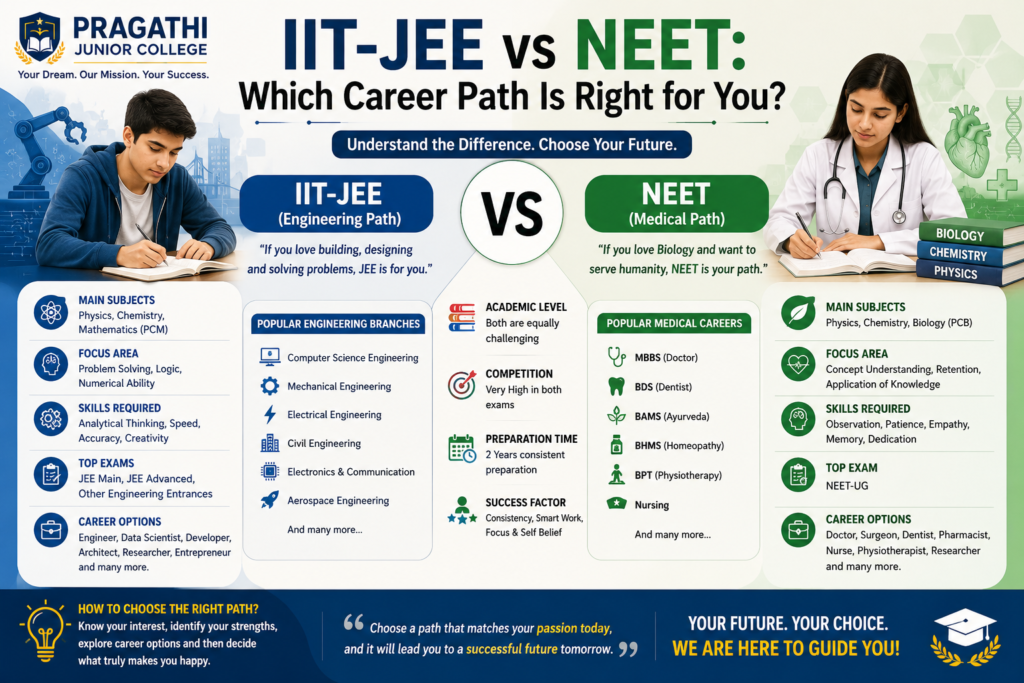
IIT-JEE vs NEET: Which Career Path Is Right for You?
Choosing a career after Class 10 or Intermediate is an important decision for students who are interested in science. Two of the most popular competitive-exam pathways in India are IIT-JEE and NEET.
Both examinations require dedication, strong subject knowledge, regular practice, and long-term preparation. However, the careers they lead to are very different.
JEE is mainly the pathway for students interested in engineering, technology, architecture, and related fields, while NEET is the primary entrance route for students who want to pursue undergraduate medical education.
So, IIT-JEE vs NEET—which one is right for you?
The answer depends on your interests, strengths, career goals, preferred subjects, and the type of work you see yourself doing in the future.
This guide compares JEE and NEET in terms of subjects, preparation, career options, difficulty, study patterns, and skills required so that students can make a more informed decision.
What Is IIT-JEE?
The Joint Entrance Examination (JEE) is a national-level engineering entrance examination pathway.
JEE Main is used for admission to several engineering institutions, including NITs, IIITs, and other participating institutes. It is also the qualifying examination for students seeking to appear for JEE Advanced, which is used for admission to the IITs.
Students interested in engineering and technology commonly choose the PCM stream:
- Physics
- Chemistry
- Mathematics
JEE preparation focuses heavily on conceptual understanding, mathematical problem-solving, numerical ability, logical thinking, and speed.
What Is NEET?
The National Eligibility cum Entrance Test (NEET-UG) is the national entrance examination for undergraduate medical education in India.
Students who want to pursue careers such as medicine generally prepare for NEET after completing the required school-level education.
The major subjects involved in NEET preparation are:
- Physics
- Chemistry
- Biology
Biology has a major role in NEET preparation, while Physics and Chemistry require conceptual understanding and regular question practice.
Students who are interested in becoming doctors, dentists, or pursuing other healthcare-related undergraduate pathways generally consider the medical entrance route.
IIT-JEE vs NEET: Basic Difference
The biggest difference between JEE and NEET is the career direction.
| Feature | IIT-JEE | NEET |
|---|---|---|
| Main Career Area | Engineering & Technology | Medicine & Healthcare |
| Core Subjects | Physics, Chemistry, Mathematics | Physics, Chemistry, Biology |
| Key Skill | Problem-solving & logical thinking | Conceptual understanding & retention |
| Mathematics | Important | Not a core NEET subject |
| Biology | Not required as a core JEE subject | Very important |
| Preparation Style | Concepts + numerical practice | Concepts + detailed study + MCQs |
| Career Examples | Engineer, Developer, Data Scientist | Doctor, Dentist, Medical Specialist |
| Major Entrance Pathway | JEE Main & JEE Advanced | NEET-UG |
The right choice depends less on which examination is “better” and more on which career matches your interests.
IIT-JEE: Who Should Choose It?
JEE may be a good fit for students who genuinely enjoy:
- Mathematics
- Physics
- Problem-solving
- Technology
- Computers
- Logical reasoning
- Engineering concepts
- Building and designing things
If you enjoy solving a difficult mathematical problem and feel motivated when you finally find the solution, engineering may suit your personality.
Students interested in areas such as software development, artificial intelligence, electronics, mechanical engineering, civil engineering, aerospace, chemical engineering, and other technical fields may consider the JEE pathway.
Skills Needed for JEE
Successful JEE preparation requires more than memorizing formulas.
Students need:
Strong Mathematical Thinking
Mathematics forms an important part of JEE preparation. Students need to develop the ability to analyze problems and apply concepts.
Problem-Solving Skills
JEE questions can require multiple steps. Students need patience and logical thinking.
Speed and Accuracy
Students must solve questions within a limited amount of time.
Conceptual Understanding
Memorizing formulas without knowing how to use them is not enough.
Consistent Practice
Regular practice is essential, particularly in Mathematics and Physics.
NEET: Who Should Choose It?
NEET may be a better fit for students who are genuinely interested in:
- Biology
- Human anatomy
- Healthcare
- Human physiology
- Medical science
- Helping patients
- Understanding diseases
- Life sciences
Students who enjoy learning about the human body and are interested in healthcare careers may find the medical pathway more suitable.
However, students should understand that becoming a doctor requires years of education and training. Therefore, choosing NEET should be based on genuine interest rather than only marks, social expectations, or perceived career status.
Skills Needed for NEET
Strong Memory and Retention
Biology requires students to remember a large amount of detailed information.
Conceptual Understanding
Students must understand processes rather than simply memorizing isolated facts.
Consistent Revision
Regular revision is critical because previously studied information can be forgotten.
Numerical Ability
Physics and parts of Chemistry require calculations and problem-solving.
Patience
Medical education is a long-term journey that requires commitment.
JEE vs NEET: Subject Difference
The subject combination is one of the clearest differences between the two pathways.
JEE – PCM
JEE aspirants generally focus on:
Physics + Chemistry + Mathematics
Mathematics requires extensive practice.
Physics requires conceptual understanding and numerical application.
Chemistry combines conceptual learning, calculations, reactions, and factual knowledge.
NEET – PCB
NEET aspirants generally focus on:
Physics + Chemistry + Biology
Biology becomes the major subject for preparation.
Physics requires numerical practice, while Chemistry requires a combination of conceptual understanding, calculations, reactions, and revision.
Which Is More Difficult: JEE or NEET?
This is one of the most common questions students ask.
There is no simple answer.
JEE and NEET test different abilities.
JEE can be challenging because of its emphasis on mathematical problem-solving, conceptual application, numerical questions, and time management.
NEET can be challenging because of the large amount of Biology content, competition, detailed preparation requirements, and the need for high accuracy.
Instead of asking which examination is harder, students should ask:
Which type of preparation suits me better?
A student who enjoys Mathematics may find JEE preparation more natural.
A student who enjoys Biology and detailed learning may prefer NEET.
JEE vs NEET: Preparation Strategy
Although both examinations require discipline, the preparation approach can differ.
JEE Preparation
A JEE aspirant should focus on:
- Strong Mathematics fundamentals
- Physics problem-solving
- Chemistry concepts
- Numerical practice
- Previous-year questions
- Mock tests
- Speed and accuracy
- Regular revision
Students should gradually move from basic problems to more challenging questions.
NEET Preparation
A NEET aspirant should focus on:
- Detailed Biology study
- Strong Physics concepts
- Chemistry preparation
- MCQ practice
- Regular revision
- Previous-year questions
- Mock tests
- Accuracy
Biology should be revised frequently to improve retention.
Can You Prepare for Both JEE and NEET?
Some students consider preparing for both JEE and NEET.
This can be possible in certain academic situations, particularly because Physics and Chemistry overlap significantly.
However, the major difference is Mathematics versus Biology.
A student attempting both may need to manage:
Physics + Chemistry + Mathematics + Biology
This creates a much larger academic workload.
Students should therefore consider their career goals carefully before choosing to prepare for both examinations.
If you already know that you want to pursue medicine, spending excessive time on JEE Mathematics may not be the most efficient use of your preparation time.
Similarly, if engineering is your goal, Biology may not need to become a major part of your competitive-exam preparation.
Career Options After JEE
Engineering offers a wide range of career opportunities.
Depending on their degree and specialization, graduates can work in fields such as:
- Software Engineering
- Artificial Intelligence
- Machine Learning
- Data Science
- Cybersecurity
- Electronics
- Mechanical Engineering
- Civil Engineering
- Electrical Engineering
- Aerospace Engineering
- Chemical Engineering
- Robotics
- Research and Development
Technology is constantly evolving, creating new opportunities for engineers with strong technical and problem-solving skills.
Career Options After NEET
The medical pathway can lead to several healthcare careers.
Students may pursue:
- Medicine
- Dentistry
- Veterinary sciences
- Medical research
- Healthcare-related specializations
- Clinical practice
- Public health
- Medical education
Students who complete medical education can later specialize in areas such as cardiology, neurology, dermatology, pediatrics, orthopedics, surgery, and many others, depending on their educational pathway.
JEE vs NEET: Which Career Has Better Scope?
Both engineering and medicine have strong career opportunities.
However, “better scope” depends on the individual.
Engineering provides opportunities across technology, manufacturing, infrastructure, research, software, and many emerging industries.
Medicine provides opportunities in healthcare, clinical practice, research, education, public health, and specialized medical fields.
Instead of selecting a career solely because someone says it has more scope, think about the type of work you want to do for many years.
Ask Yourself These Questions
Before choosing JEE or NEET, ask:
1. Which Subject Do I Enjoy More?
Do you enjoy Mathematics and logical problem-solving?
Or do you enjoy Biology and understanding living systems?
2. What Kind of Problems Do I Like Solving?
Do you enjoy mathematical and technical challenges?
Or are you interested in understanding the human body and healthcare?
3. What Career Do I Imagine?
Can you see yourself designing technology, developing software, building systems, or working in engineering?
Or do you see yourself treating patients, studying medicine, and working in healthcare?
4. Am I Choosing This Because I Want It?
This is one of the most important questions.
Do not choose JEE or NEET only because your friends are choosing it or because someone else expects you to.
Your interest matters.
JEE vs NEET for Class 11 Students
Class 11 is an ideal time to evaluate your strengths before committing fully to a competitive-exam pathway.
Students should use the beginning of Class 11 to understand:
- Which subjects they enjoy
- Which subjects they perform well in
- What type of questions they enjoy solving
- What career they want to explore
- How they respond to competitive preparation
Do not panic if you are initially unsure.
Talk to teachers, parents, mentors, and professionals before making a major decision.
How Pragathi Junior College Supports JEE and NEET Aspirants
Choosing the right junior college can provide students with a structured academic environment during the crucial Class 11 and 12 years.
Pragathi Junior College supports students preparing for competitive examinations such as JEE and NEET while they continue their intermediate education.
A structured preparation environment can help students through:
- Experienced faculty
- Subject-focused teaching
- Competitive-exam preparation
- Regular assessments
- Doubt-clearing sessions
- Study materials
- Performance analysis
- Revision planning
- Academic guidance
Students and parents should compare academic programs, teaching methods, faculty experience, testing systems, study resources, and student support before choosing an institution.
Final Verdict: IIT-JEE or NEET?
There is no universal winner in the IIT-JEE vs NEET comparison.
The better choice is the one that matches your interests, abilities, personality, and long-term career goals.
Choose JEE if you enjoy Mathematics, Physics, technology, logical reasoning, and engineering-related problem-solving.
Choose NEET if you enjoy Biology, medical science, human anatomy, healthcare, and are prepared for the long-term commitment involved in medical education.
Your entrance examination is only the beginning of your career journey.
The most important decision is to choose a path that you can stay committed to even when the preparation becomes difficult.
Frequently Asked Questions
Is JEE better than NEET?
Neither examination is universally better. JEE and NEET lead toward different career paths. The right choice depends on your interests and career goals.
Is NEET harder than JEE?
Both are highly competitive and challenging in different ways. JEE emphasizes mathematical and analytical problem-solving, while NEET requires strong Biology preparation along with Physics and Chemistry.
Can a PCB student write JEE?
JEE preparation generally requires Mathematics for engineering programs, so students should carefully check the current eligibility requirements and subject requirements before choosing their academic combination.
Can a PCM student prepare for NEET?
NEET requires Biology/Biotechnology along with Physics and Chemistry under the applicable eligibility rules. Students should verify the latest official eligibility requirements before planning their subject combination.
Should I choose JEE or NEET after Class 10?
Consider your interests first. If you enjoy Mathematics and technology, explore the engineering pathway. If Biology and healthcare interest you more, explore the medical pathway.
Can I prepare for JEE and NEET together?
It is possible in some circumstances, but preparing for both can create a heavy workload because of the additional Mathematics and Biology requirements. Students should choose based on their long-term career goals.