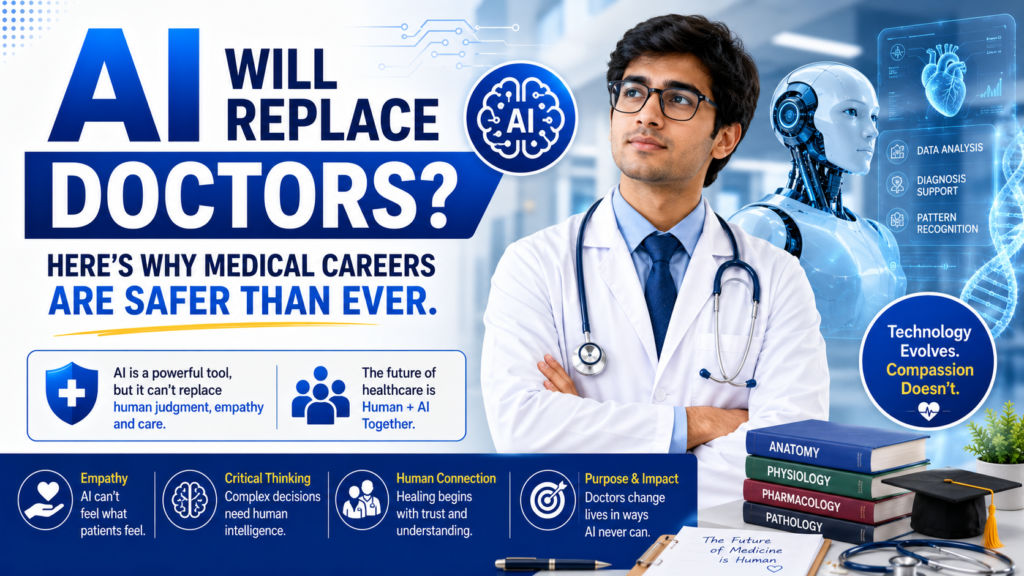
Will AI Replace Doctors? Here’s Why Medical Careers Are Safer Than Ever
Artificial Intelligence (AI) is transforming industries across the world. From self-driving cars to virtual assistants and automated customer service, AI has become a part of everyday life. Naturally, students and parents are beginning to ask an important question:
“Will AI replace doctors in the future?”
With AI-powered diagnostic tools, robotic surgery, and advanced medical technologies making headlines, it’s easy to assume that doctors may eventually become unnecessary. However, the reality is much more balanced.
AI is changing how healthcare is delivered, but it is not replacing doctors. Instead, it is becoming a powerful tool that helps medical professionals make better decisions, improve efficiency, and provide higher-quality patient care.
If you’re preparing for NEET or planning a career in medicine, here’s why the future of medical careers remains bright.
The Rise of AI in Healthcare
Artificial Intelligence is already helping hospitals and healthcare providers in many ways.
Today, AI can:
- Analyze medical images
- Detect disease patterns
- Organize patient records
- Predict health risks
- Assist in drug discovery
- Support clinical decision-making
These advancements help doctors work faster and more accurately.
However, AI performs these tasks by analyzing large amounts of data. It does not replace the human qualities that define medical care.
Medicine Is More Than Diagnosis
Many people believe doctors simply diagnose illnesses and prescribe medicines.
In reality, medicine involves much more.
Doctors must:
- Listen carefully to patients
- Understand symptoms and medical history
- Interpret test results within the patient’s overall condition
- Explain treatment options
- Provide emotional reassurance
- Make ethical decisions
- Adapt treatment plans when conditions change
These responsibilities require communication, empathy, judgment, and experience—qualities that AI cannot fully replicate.
The Human Connection Matters
When patients receive difficult news or face serious illnesses, they look for compassion, understanding, and trust.
A machine can process information, but it cannot truly understand a patient’s emotions or provide genuine human reassurance.
Doctors build relationships with patients and families over time. This human connection remains one of the most important parts of healthcare.
AI Is a Tool, Not a Replacement
Think of AI as an advanced medical assistant.
It can help doctors by:
- Identifying patterns in scans
- Highlighting possible diagnoses
- Reducing paperwork
- Improving workflow
- Supporting treatment planning
The final clinical decisions, however, remain the responsibility of qualified healthcare professionals.
AI improves efficiency, while doctors provide expertise and accountability.
Why Medical Careers Remain Strong
Healthcare demand continues to grow due to several factors:
Growing Population
As populations increase, more healthcare professionals are needed to provide medical services.
Longer Life Expectancy
People are living longer, increasing the need for doctors who manage chronic illnesses and age-related conditions.
New Diseases and Health Challenges
Emerging diseases and changing health trends require continuous medical research and skilled healthcare professionals.
Advances in Medical Science
Medical technology creates new specialties and career opportunities rather than reducing them.
Doctors continue to play a central role in adopting and applying these innovations.
Skills Future Doctors Need
Tomorrow’s doctors will benefit from combining medical knowledge with technological awareness.
Important skills include:
- Clinical reasoning
- Communication
- Empathy
- Problem-solving
- Teamwork
- Digital literacy
- Lifelong learning
Understanding AI tools will become an advantage, but human judgment will remain essential.
AI Creates New Opportunities in Medicine
Rather than reducing careers, AI is creating exciting new fields.
Examples include:
- Medical Informatics
- Digital Health
- Clinical Data Science
- Healthcare Technology
- Precision Medicine
- Robotic Surgery Support
- Telemedicine
Students interested in both medicine and technology may find even more career options in the future.
What This Means for NEET Aspirants
If you’re preparing for NEET, don’t let headlines discourage you.
Focus on:
- Building strong Biology fundamentals
- Developing scientific thinking
- Improving communication skills
- Staying curious about medical advancements
- Learning continuously
Medicine remains one of the most respected and impactful professions.
Role of Medical Colleges
Modern medical education increasingly includes technology alongside traditional medical training.
Students now learn about:
- Electronic health records
- Medical imaging technologies
- Digital healthcare systems
- AI-assisted diagnostics
- Evidence-based medicine
Future doctors will graduate with the knowledge needed to work alongside advanced technologies.
Should Students Worry About AI?
No.
Students should view AI as a helpful resource rather than a threat.
Doctors who understand technology will likely have even greater opportunities in the coming years.
The goal is not to compete with AI but to use it effectively to improve patient care.
Advice for Parents
Parents sometimes worry that technological changes will affect career stability.
Healthcare continues to be one of the world’s most essential professions because every society needs qualified medical professionals.
Encourage students to:
- Stay motivated
- Focus on conceptual learning
- Develop communication skills
- Embrace technological advancements
- Build strong ethical values
These qualities will remain valuable regardless of future innovations.
The Future of Medicine
The future hospital will likely include:
- AI-assisted diagnosis
- Smart medical devices
- Robotic surgical systems
- Personalized treatment planning
- Digital patient monitoring
Yet every step will still require trained doctors to interpret information, communicate with patients, and make clinical decisions.
Technology will enhance healthcare—not replace the professionals who deliver it.
Conclusion
Artificial Intelligence is transforming healthcare, but it is not eliminating the need for doctors. Instead, it is changing how doctors work by providing better tools, faster analysis, and improved access to medical information.
The qualities that define great doctors—empathy, ethical judgment, communication, critical thinking, and clinical expertise—cannot be replaced by algorithms alone.
For students preparing for NEET and aspiring to become doctors, the future remains full of opportunity. By combining strong medical knowledge with an openness to new technologies, tomorrow’s healthcare professionals will be better equipped than ever to improve lives.
Rather than fearing AI, embrace it as a powerful partner in delivering safer, smarter, and more effective healthcare.
Frequently Asked Questions (FAQs)
1. Will AI completely replace doctors?
Current evidence suggests AI is designed to support doctors, not replace them. It assists with tasks such as data analysis and diagnostics, while doctors continue to make clinical decisions and provide patient care.
2. Can AI diagnose diseases?
AI can help identify patterns and assist in diagnosing certain conditions, but qualified healthcare professionals interpret results and determine the appropriate treatment.
3. Is medicine still a good career despite AI?
Yes. Healthcare demand continues to grow, and AI is creating additional opportunities while helping doctors work more efficiently.
4. Should NEET aspirants learn about AI?
A basic understanding of AI and digital healthcare can be valuable, but students should first focus on building strong medical and scientific foundations.
5. What skills will future doctors need?
Future doctors will benefit from clinical knowledge, communication, empathy, ethical decision-making, teamwork, critical thinking, and the ability to use new healthcare technologies effectively.