
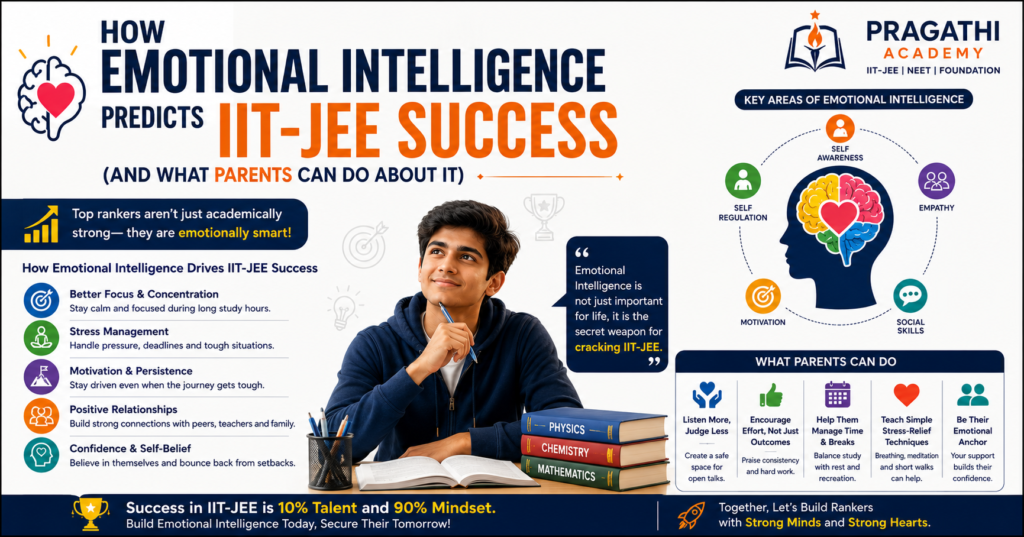
How Emotional Intelligence Predicts IIT-JEE Success (And What Parents Can Do About It)
Introduction
When parents think about IIT-JEE success, they usually focus on intelligence, study hours, coaching quality, mock tests, and academic performance. While these factors undoubtedly matter, there is another powerful predictor of success that often goes unnoticed: Emotional Intelligence (EI).
Every year, thousands of talented students prepare for the Joint Entrance Examination (JEE), one of India’s most competitive entrance exams. Yet many students with strong academic abilities struggle to perform to their potential. Meanwhile, others with similar or even lower academic profiles manage to stay consistent, handle pressure effectively, and achieve exceptional results.
What makes the difference?
Increasingly, educators and psychologists point to emotional intelligence as a key factor.
Emotional intelligence is the ability to understand, manage, and effectively use emotions in everyday situations. For JEE aspirants, it influences how they respond to stress, setbacks, competition, failure, and uncertainty.
In a journey that typically spans two years or more, emotional resilience often becomes just as important as academic capability.
What Is Emotional Intelligence?
Emotional Intelligence (EI), often referred to as Emotional Quotient (EQ), is the ability to recognize, understand, and manage emotions while also understanding the emotions of others.
Psychologists generally describe emotional intelligence through five key components:
1. Self-Awareness
Understanding one’s emotions, strengths, weaknesses, and reactions.
2. Self-Regulation
Managing emotions effectively during difficult situations.
3. Motivation
Maintaining focus and commitment despite obstacles.
4. Empathy
Understanding the feelings and perspectives of others.
5. Social Skills
Building healthy relationships and communicating effectively.
While IQ helps students solve complex problems, EQ helps them navigate the challenges that arise during preparation.
Why IIT-JEE Is an Emotional Marathon
Many people think JEE preparation is purely academic.
The reality is different.
Students preparing for IIT-JEE often face:
- Long study schedules
- Academic pressure
- Frequent testing
- Peer competition
- Performance anxiety
- Fear of failure
- Uncertainty about results
- Expectations from family and society
These challenges create emotional demands that cannot be solved through intelligence alone.
A student may understand every physics concept perfectly but still underperform if anxiety takes over during the examination.
This is where emotional intelligence becomes critical.
The Link Between Emotional Intelligence and JEE Success
Better Stress Management
JEE preparation inevitably involves stress.
Students with high emotional intelligence are better equipped to:
- Recognize stress early
- Manage anxiety
- Maintain perspective
- Recover from setbacks
Instead of panicking after a poor test score, they analyze mistakes and move forward constructively.
This ability to recover quickly often determines long-term success.
Greater Consistency
Success in JEE rarely comes from occasional bursts of effort.
It comes from consistent work over months and years.
Emotionally intelligent students are more likely to:
- Follow routines
- Stay disciplined
- Avoid emotional burnout
- Maintain steady performance
Consistency often beats short-term intensity.
Improved Focus
Emotional distractions can significantly affect concentration.
Students dealing with:
- Fear
- Self-doubt
- Frustration
- Comparison
often struggle to focus effectively.
Students with stronger emotional intelligence learn to manage these feelings, allowing them to devote more mental energy to learning.
Better Decision-Making
JEE preparation requires hundreds of decisions:
- Which topics need attention?
- When should mock tests be taken?
- How should time be allocated?
- Which mistakes require correction?
Emotionally intelligent students make decisions based on logic rather than emotional reactions.
This leads to more efficient preparation strategies.
Resilience After Failure
Failure is part of the JEE journey.
Every student experiences:
- Difficult chapters
- Low mock-test scores
- Temporary setbacks
The difference lies in how they respond.
Emotionally intelligent students view setbacks as learning opportunities rather than evidence of inadequacy.
This resilience often separates successful candidates from those who give up prematurely.
Signs of Strong Emotional Intelligence in JEE Aspirants
Parents and educators can look for several indicators.
Emotionally intelligent students typically:
- Accept constructive feedback
- Handle criticism calmly
- Maintain healthy study habits
- Recover quickly from poor results
- Seek help when needed
- Stay motivated despite challenges
- Avoid excessive comparison
- Remain optimistic during difficult periods
These traits contribute significantly to long-term academic success.
Common Emotional Challenges During JEE Preparation
Fear of Failure
Many students become overwhelmed by thoughts such as:
- “What if I don’t qualify?”
- “What if I disappoint my parents?”
- “What if my friends perform better?”
These fears can create unnecessary pressure.
Perfectionism
Some students believe every test score must be perfect.
When reality doesn’t match expectations, frustration and self-criticism increase.
Healthy progress is often more valuable than perfection.
Social Comparison
Comparing performance with peers has become increasingly common.
While healthy competition can motivate students, excessive comparison often damages confidence.
Burnout
Long periods of intense preparation without adequate recovery can lead to emotional exhaustion.
Symptoms may include:
- Reduced motivation
- Irritability
- Fatigue
- Difficulty concentrating
Recognizing burnout early is essential.
What Parents Can Do to Develop Emotional Intelligence
Parents play a crucial role in shaping emotional resilience.
Here are practical ways they can help.
1. Focus on Effort, Not Just Results
Instead of asking:
“What was your rank?”
Try asking:
“What did you learn today?”
This shift encourages growth-oriented thinking.
Students become more focused on improvement rather than outcomes alone.
2. Normalize Setbacks
Every successful IIT aspirant faces failures.
Parents should communicate that:
- Mistakes are normal.
- Poor scores are temporary.
- Improvement is always possible.
Children who understand this develop stronger resilience.
3. Encourage Open Communication
Students should feel comfortable discussing:
- Stress
- Anxiety
- Frustration
- Academic concerns
Judgment-free conversations create emotional safety.
When students feel heard, they are more likely to seek support when needed.
4. Avoid Excessive Comparison
Comparisons often undermine confidence.
Statements such as:
“Your friend scored higher.”
may create unnecessary pressure.
Instead, focus on personal progress.
Each student’s journey is unique.
5. Teach Problem-Solving Skills
When challenges arise, encourage students to think through solutions.
Ask:
- What caused this issue?
- What can be improved?
- What is the next step?
This promotes independence and emotional maturity.
6. Model Emotional Intelligence
Children learn by observation.
Parents who manage stress calmly, communicate respectfully, and handle setbacks constructively provide powerful examples.
Emotional intelligence is often taught more effectively through behavior than instruction.
7. Support Healthy Routines
Strong emotional health depends on:
- Adequate sleep
- Physical activity
- Balanced nutrition
- Recreation
- Social interaction
Students perform best when their physical and emotional needs are met.
Building Emotional Intelligence Through Daily Habits
Small habits can create significant improvements.
Students can practice:
Reflection
Spending a few minutes each day reviewing:
- Successes
- Challenges
- Lessons learned
Gratitude
Focusing on positive experiences improves emotional balance.
Mindfulness
Simple mindfulness exercises can reduce anxiety and improve concentration.
Goal Setting
Breaking large objectives into smaller milestones helps maintain motivation.
Positive Self-Talk
Replacing negative thoughts with constructive ones improves confidence and resilience.
Why Emotional Intelligence Matters Beyond IIT-JEE
Even after JEE, students encounter new challenges:
- College life
- Competitive environments
- Career decisions
- Professional responsibilities
Emotional intelligence remains valuable throughout life.
Research consistently shows that emotionally intelligent individuals often perform better in leadership roles, teamwork situations, and high-pressure environments.
Therefore, developing emotional intelligence is not merely an exam strategy—it is a life skill.
The Future of Student Success
Educational success is evolving.
Today’s most successful students are not simply those with the highest IQs.
They are often those who can:
- Adapt to change
- Manage emotions
- Recover from setbacks
- Build healthy relationships
- Stay motivated under pressure
These are all qualities associated with emotional intelligence.
As academic competition becomes increasingly intense, emotional resilience may become one of the most important differentiators.
Conclusion
IIT-JEE preparation is often viewed as a test of academic excellence. In reality, it is also a test of emotional strength.
While intelligence, coaching, and hard work remain essential, emotional intelligence plays a powerful role in determining how effectively students handle the challenges of the journey.
Students with strong emotional intelligence are better equipped to manage stress, maintain consistency, recover from setbacks, and perform at their best when it matters most.
Parents have a unique opportunity to nurture these skills by creating supportive environments, encouraging healthy perspectives on success and failure, and helping students develop resilience.
In the long run, emotional intelligence doesn’t just help students crack IIT-JEE.
It helps them succeed in college, careers, relationships, and life itself.